ADVERTISEMENT
Phase 1: Vegetable Preparation and Moisture Control
- **Manage Moisture (MOISTURE MANDATE):** After dicing the **cucumber** and halving the **cherry tomatoes**, place them in a bowl and sprinkle lightly with **salt**. Let them sit for $10\text{ minutes}$, then gently pat them dry with paper towels to remove excess moisture that the salt has drawn out.
- **Combine Aromatics:** In a large mixing bowl, combine the **diced cucumber, red bell pepper, red onion, cherry tomatoes, and fresh parsley/cilantro**.
- **Dress and Season (FLAVOR INTEGRATION):** Pour the **lemon juice** and **olive oil** (if using) over the vegetables. Add the **dried dill, salt, and pepper**. Toss gently until evenly coated.
Phase 2: Final Assembly and Integration
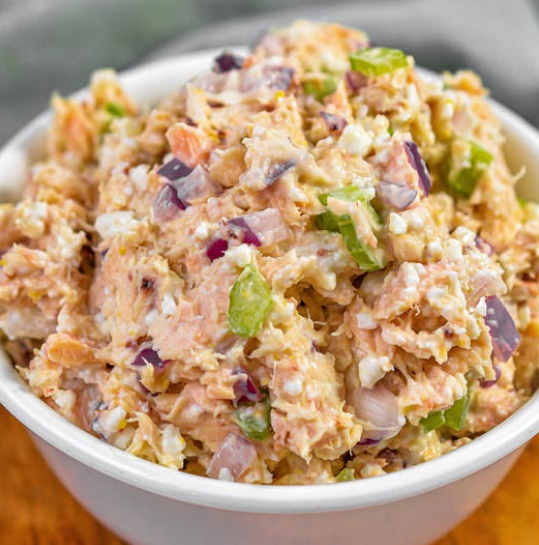
- **Add Cottage Cheese:** Gently fold in the **cottage cheese** to the vegetable mixture. Mix carefully to ensure the cottage cheese coats the vegetables without completely breaking down the curds.
- **Chill and Serve (CHILL PROTOCOL):** Cover and refrigerate the salad for at least **$30\text{ minutes}$** to allow the flavors to marry. Taste again before serving and adjust salt or pepper as needed.
- **Serving Suggestions:** Serve chilled, either spooned over toast, lettuce cups, or enjoyed straight.
Serving and Storage: Post-Mix Stability
Optimal handling for this fresh, high-moisture salad:
- **Serving:** Serve chilled. If the salad is left at room temperature for over an hour, the vegetables will release more water, and the dairy base will soften.
- **Storage:** Store leftovers in an airtight container in the refrigerator for up to **3 days**.
- **Make-Ahead Strategy:** To ensure maximum freshness and minimal wateriness for a future event, mix all the **vegetables** and the **lemon juice/olive oil** (Instruction 3) ahead of time. Store the cottage cheese separately. Combine the mixture and the cottage cheese **no more than 1 hour** before serving.
Tips: Essential Techniques for Texture and Non-Wateriness
The Salt Draw: Do not skip the initial salting and draining of the cucumber/tomato (Instruction 1). This simple step is the **most effective way** to prevent the salad from becoming watery upon standing.
Cottage Cheese Choice: Using cottage cheese with **smaller curds** will create a smoother final texture that is more akin to a traditional salad dressing base. If you prefer a richer texture, choose full-fat cottage cheese.
Red Onion Rinse: **Finely chopping and rinsing the red onion** under cold water for $30\text{ seconds}$ (before adding it to the salad) removes some of the strong sulfurous compounds, mellowing its harsh flavor and making it blend better with the creamy cottage cheese base.
Acidic Base: The **lemon juice** (Ingredient I) is non-negotiable. Its acidity brightens the flavor of the otherwise heavy dairy and helps balance the earthiness of the vegetables.
Mashed Curds: If you prefer a smoother, mayonnaise-like dressing, scoop $\frac{1}{4}\text{ cup}$ of the **cottage cheese** into a small bowl and mash it vigorously with a fork until it forms a creamy paste. Mix this paste with the rest of the curds before adding the vegetables (Instruction 4).
Variations: Customizing Protein and Spices
Easily adapt the flavor profile of the salad:
- **Added Protein:** Stir in $\frac{1}{2}\text{ cup}$ of **shredded, cooked chicken breast** or **canned tuna (well-drained)** along with the cottage cheese for an extra layer of protein and a more traditional “salad” feel.
- **Avocado Creaminess:** Mash $\frac{1}{4}\text{ of an avocado}$ and fold it into the cottage cheese base (Instruction 4) for extra healthy fats and a smooth, vibrant green hue.
- **Curry Spice:** For an Indian-inspired flavor, replace the **dill and parsley** with $\frac{1}{2}\text{ teaspoon}$ of **curry powder** and a pinch of **turmeric**.
- **Crunch Factor:** Stir in $\frac{1}{4}\text{ cup}$ of **toasted slivered almonds or sunflower seeds** just before serving (Instruction 5) for necessary textural contrast.
**Diced Size:** Dice all vegetables (cucumber, bell pepper, onion) to a **small, uniform size** (about $1/4\text{ inch}$). This ensures that every bite contains a balanced mix of all flavors and textures.
**Herb Use:** When using **fresh herbs** (like parsley or cilantro), always chop them immediately before adding them to the salad (Instruction 2). This maximizes the release of their volatile aromatic oils, resulting in the freshest flavor.
**Serving Temperature:** Serving the salad **straight from the refrigerator** maximizes the crunchiness of the vegetables and the firmness of the cottage cheese curds, ensuring a pleasant texture contrast.
**Smoked Paprika:** A pinch of **smoked paprika** added to the cottage cheese base (Ingredient I) provides an unexpected savory, almost smoky depth that can mimic the flavor profile often found in cured meats.
Conclusion: A Balanced and Satisfying Meal
The **Healthy High-Protein Cottage Cheese Salad** is a technical success achieved through thoughtful ingredient preparation. By strictly enforcing **The Moisture Management Mandate** to maintain the salad’s structure and leveraging **The Chill and Integrate Protocol** to harmonize the fresh, pungent, and creamy components, you create a satisfying, low-carb, and flavorful meal that stays fresh and delicious.
Frequently Asked Questions (FAQ)
Q: Why did my salad get watery after a few hours?
A: The **vegetables were not sufficiently drained** (failure of **The Moisture Management Mandate**, Instruction 1). The salt in the dressing continued to draw out moisture (osmosis). Follow the make-ahead strategy (Tip 5) for best results.
Q: Can I use plain Greek yogurt instead of cottage cheese?
A: **Yes**, but the texture will be significantly different. Greek yogurt provides the protein but lacks the structural integrity of the cottage cheese curds. The resulting salad will be smoother and more liquid.
Q: My red onion flavor is too harsh. How can I mellow it?
A: Mellow the raw onion flavor by **finely chopping it and soaking it in cold water for $5\text{ minutes}$**, then draining and patting dry (Tip 6) before adding it to the mix.
Q: What is the best low-carb way to serve this salad?
A: Serve the salad in **large iceberg or butter lettuce cups**, or use **celery sticks or bell pepper slices** as dippers (Serving Suggestions).
ADVERTISEMENT