
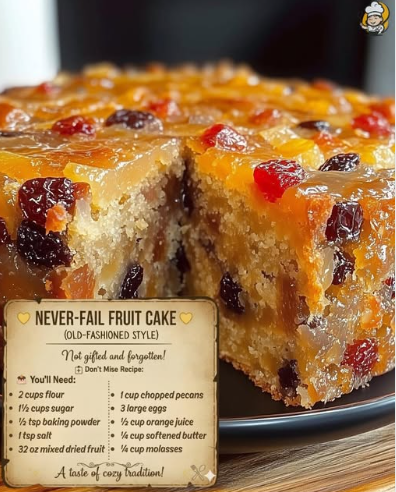
Holiday Heritage: Mastering Never-Fail Old-Fashioned Fruit Cake
Introduction: A Cake Built to Last
This **Old-Fashioned Fruit Cake** is a dark, heavy, and moist holiday classic. Unlike lighter cakes, its dense structure and high sugar content allow it to keep for weeks, maturing in flavor over time—especially when “fed” with spirits.
The texture of this fruit cake is not fluffy; it is dense and moist, often described as more of a candied fruit bar held together by a rich batter. The cake’s dark color and deep flavor come from the **$\frac{1}{4}$ cup of molasses**, which also contributes crucial moisture and browning. The **32 oz of mixed dried fruit** is the structural star, often outweighing the **2 cups of flour**.
Success requires adherence to three core regulations: **The Fruit Suspension Ratio, The Long, Low-Temp Bake, and The Spirit Feeding Ritual.**
The first regulation, **The Fruit Suspension Ratio** (Instruction 2), addresses the key problem in fruit cake: sinking. By lightly tossing the **32 oz of mixed dried fruit** and **1 cup of chopped pecans** in a portion of the flour mixture before adding the wet ingredients, we create a thin, starchy coating. This coating prevents the heavy fruit from sinking to the bottom during the long bake, ensuring even distribution throughout the cake.
The second regulation, **The Long, Low-Temp Bake** (Instruction 4), prevents the cake from drying out. Because of its density and high sugar content, fruit cake must be baked at a low temperature—around $150^\circ\text{C}$ to $165^\circ\text{C}$ ($300^\circ\text{F}$ to $325^\circ\text{F}$)—for an extended period (1.5 to 2 hours). This gentle heat ensures the center cooks through without burning the exterior or evaporating too much of the precious internal moisture.
The third regulation, **The Spirit Feeding Ritual** (Instruction 5, optional but highly traditional), is what makes the cake unique. Immediately after baking and while still warm, the cake is brushed or “fed” with a tablespoon or two of a spirit like **brandy or dark rum**. This practice not only adds deep, complex flavor over time but also acts as a natural preservative, allowing the cake to be stored for several weeks, improving its moisture and flavor profile with age.
Ingredients: Defining Dark Flavor and Structure
The complete list of components for this rich, dense fruit cake:
I. The Dry Structure:
- **2 cups** all-purpose flour
- **1½ cups** granulated sugar
- **$\frac{1}{2}$ tsp** baking powder
- **1 tsp** salt
- **$\frac{1}{2}$ tsp** baking soda (Activated by molasses and orange juice)
- **1 tsp** ground cinnamon; **$\frac{1}{2}$ tsp** ground nutmeg; **$\frac{1}{4}$ tsp** ground cloves (The classic spice blend)
II. The Moistening Agents:
- **3 large** eggs
- **$\frac{1}{2}$ cup** orange juice (The acid)
- **$\frac{1}{4}$ cup** softened butter
- **$\frac{1}{4}$ cup** molasses (For dark color and depth of flavor)
- **2 tbsp** dark rum or brandy (For feeding/flavor – *Optional*)
III. The Heavy Add-ins:
- **32 oz** mixed dried fruit (e.g., raisins, currants, candied citrus peel)
- **1 cup** chopped pecans (or walnuts)
