ADVERTISEMENT
Phase 1: Preparing the Batter and Fruit
- **Prep Oven and Pan:** Preheat your oven to **$150^\circ\text{C}$ ($300^\circ\text{F}$)**. Grease a $9\text{x}5\text{ inch}$ loaf pan or a 10-inch tube pan and line it with parchment paper, leaving an overhang on the sides for easy removal.
- **Flour the Fruit (FRUIT SUSPENSION RATIO):** In a very large bowl, combine the **32 oz mixed dried fruit** and **1 cup chopped pecans**. Toss them with **$\frac{1}{2}$ cup of the measured flour** until fully coated. Set aside.
- **Mix Batter:** Whisk together the remaining **$1\frac{1}{2}$ cups flour, sugar, baking powder, baking soda, salt, cinnamon, nutmeg, and cloves**. In a separate bowl, cream the **softened butter** until light. Beat in the **eggs** one at a time, followed by the **molasses, vanilla extract, and orange juice**.
- **Combine:** Add the dry ingredients to the wet ingredients and mix until just combined. Fold in the floured fruit and nut mixture until everything is evenly distributed. The batter will be very stiff and heavy.
Phase 2: Baking and Feeding
- **Bake (LONG, LOW-TEMP BAKE):** Spoon the stiff batter into the prepared pan, pressing it down lightly to eliminate air pockets. Bake at **$150^\circ\text{C}$ ($300^\circ\text{F}$)** for **1.5 to 2 hours** for a loaf pan, or up to 3 hours for a tube pan. The cake is done when a skewer inserted into the center comes out with moist crumbs, not wet batter.
- **Cool and Feed (SPIRIT FEEDING RITUAL):** Let the cake cool in the pan for 15 minutes. While still warm, **gently prick the entire top surface** with a skewer. Brush the top with **1 tablespoon of dark rum or brandy** (or orange juice for an alcohol-free version).
- **Age:** Remove the cake from the pan and cool completely. Wrap the cake tightly in cheesecloth soaked in brandy, then plastic wrap, and finally aluminum foil. Store in a cool, dark place. For maximum flavor, **feed the cake with an additional $\frac{1}{2}\text{ tbsp}$ of spirit every week** until serving (optional).
Serving and Storage: The Maturation Process
Optimal handling for this long-keeping cake:
- **Serving:** Best served after aging for at least **1 week** (and up to 1 month) to allow the flavors to deepen and the moisture to redistribute. Serve thinly sliced.
- **Storage (Aged):** Store wrapped as described in Step 7. The high sugar/alcohol content acts as a preservative; the cake can keep at cool room temperature for **up to 6 weeks**.
- **Moisture Check:** If the cake begins to feel dry, lightly brush it with the spirit of your choice or a simple syrup before serving.
Tips: Essential Techniques for Color and Texture
Baking Soda and Molasses: The **$\frac{1}{2}\text{ tsp}$ of baking soda** (Ingredient I) is crucial. It reacts with the acidic **orange juice** and the **molasses** to produce a slightly darker color and a fine crumb, making the cake lighter than if baking powder were used alone.
Don’t Over-Mix: Once the flour is added (Step 4), mix only until the flour streaks disappear. Over-mixing will develop gluten, which creates a tough, dry cake—especially noticeable with such a dense batter.
The Steam Tent: If the top of the cake begins to brown too quickly during the long bake (Step 5), lightly cover the pan with a piece of **aluminum foil** to deflect the heat and allow the interior to finish baking.
Pan Lining: Lining the pan with **parchment paper** (Step 1) is absolutely necessary. The high sugar content in the cake will cause it to stick stubbornly to the pan without this barrier.
Fruit Preparation: Before using, you can **soak the dried fruit** in hot tea or the spirit of your choice for 30 minutes. Drain before tossing with flour (Step 2). This plumps the fruit and prevents it from stealing moisture from the batter.
Variations: Customizing Spices and Spirits
Easily adapt the flavor profile of the fruit cake:
- **Lighter Fruit Cake:** Substitute the **molasses** with an equal amount of **honey or light corn syrup**. Omit the ground cloves for a lighter color and flavor.
- **Tropical Fruit Cake:** Use a blend of **dried pineapple, mango, and coconut flakes** for the 32 oz fruit blend (Ingredient III). Feed with **white rum** instead of dark rum (Step 6).
- **Chocolate Finish:** Melt **$\frac{1}{4}$ cup of dark chocolate** and drizzle it over the cooled cake (Step 6) before wrapping.
- **Black Tea Soak:** Substitute the **orange juice** (Ingredient II) with an equal amount of strongly brewed black tea for a more earthy, less citrusy flavor.
**Testing Doneness:** Because of the cake’s density, insert the skewer (Step 5) in a few different places to confirm doneness across the pan. The center requires the most time.
**Molasses Measurement:** To prevent the **molasses** (Ingredient II) from sticking to your measuring cup, first lightly coat the cup with a small amount of the measured **oil or butter**. The molasses will slide right out.
**Cake Pan Material:** Use a **dark metal pan** (Step 1) for this recipe. Darker pans absorb more heat, which aids in the deep browning and caramelization necessary for the fruit cake flavor.
**Why Flour the Fruit?:** **The Fruit Suspension Ratio** (Step 2) works because the starch in the flour creates a dry, non-slippery surface on the fruit, allowing the batter to hold the pieces in suspension against gravity and preventing them from dragging the batter down.
Conclusion: The Reward of Patience
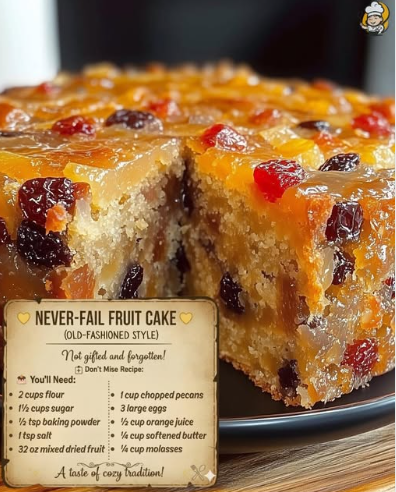
The **Old-Fashioned Fruit Cake** is a labor of love defined by time and tradition. By mastering **The Fruit Suspension Ratio** to prevent sinking, utilizing **The Long, Low-Temp Bake** for a moist core, and adhering to **The Spirit Feeding Ritual** for flavor maturation, you create a complex, delicious cake that embodies the holiday spirit. The dense, flavorful result is worth the patience required for this classic recipe to age into perfection.
Frequently Asked Questions (FAQ)
Q: Why did all the fruit sink to the bottom?
A: You likely skipped or improperly executed **The Fruit Suspension Ratio** (Step 2). The heavy fruit must be lightly coated in flour to keep it from sinking into the batter.
Q: My cake is dry and crumbly. What happened?
A: The cake was most likely **overbaked** (Step 5) or the oven temperature was too high. The long, low-temp bake is essential to trap moisture.
Q: Is the spirit feeding necessary?
A: **No**, it is optional (Step 6). However, the alcohol acts as a preservative and significantly enhances the flavor and moisture over weeks of aging, which is the traditional method.
Q: Can I use fresh fruit instead of dried?
A: **No**. Fresh fruit (like apples or pears) contains too much water and will not set properly; it will turn the cake soggy and interfere with the final structure.
ADVERTISEMENT