
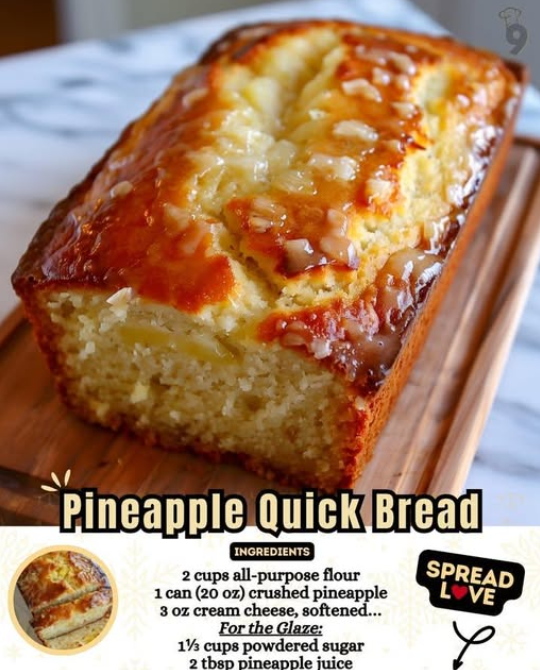
Baking Basics: Mastering Pineapple Quick Bread
Introduction: The Chemistry of the Quick Bread
A **Quick Bread** is defined by its reliance on chemical leaveners like baking soda or baking powder, allowing it to be prepared and baked quickly without yeast fermentation. This **Pineapple Quick Bread** balances the sweetness of sugar and fruit with the acidity of **sour cream** (Ingredient I) and **crushed pineapple** (Ingredient I). This acidity is essential because it reacts with **baking soda** (Ingredient I) to create carbon dioxide gas, which gives the bread its lift and tender crumb. This is the core of **The Moisture and Acidity Mandate**.
The main challenge in quick bread baking is **overmixing**. When flour and liquid combine, gluten proteins begin to form. Excessive mixing overdevelops the gluten, resulting in a tough, dense, or chewy loaf, often identifiable by tunneling (long, narrow holes) inside the bread. Therefore, strict adherence to **The Gentle Mixing Protocol** (Instruction 5) is non-negotiable.
Success requires adherence to three core regulations: **The Moisture and Acidity Mandate, The Gentle Mixing Protocol, and The Temperature Consistency Principle.**
The first regulation, **The Moisture and Acidity Mandate** (Ingredient I), focuses on the leavening reaction. The $\frac{1}{2}\text{ cup}$ of **sour cream** and the acidic **pineapple juice** ensure there is enough acid to fully activate the $\frac{1}{2}\text{ teaspoon}$ of **baking soda**. Sour cream also contributes significant fat, inhibiting gluten formation and promoting a delicate, moist texture.
The second regulation, **The Gentle Mixing Protocol** (Instruction 5), prevents gluten overdevelopment. Wet and dry ingredients are mixed separately and then combined only until the flour is *just* incorporated, often leaving small lumps. These small lumps are acceptable, as mixing beyond this point to achieve a perfectly smooth batter will inevitably result in a tough texture.
The third regulation, **The Temperature Consistency Principle** (Instruction 3), ensures proper emulsification. The **eggs** and **oil** (or butter) must be fully blended with the **sugar** before the flour is added. Using room temperature eggs helps the batter emulsify smoothly and uniformly, which supports an even rise in the oven.
Ingredients: Defining Structure, Moisture, and Lift
The full components for one standard loaf ($9\times 5\text{-inch}$ pan):
I. Dry & Acidity (Structure and Lift):
- **$2\text{ cups}$** all-purpose flour (Structure)
- **$1\text{ cup}$** sugar (Sweetener, tenderizer)
- **$1\text{ teaspoon}$** baking powder (Secondary leavener)
- **$\frac{1}{2}\text{ teaspoon}$** baking soda (Primary leavener, activated by acid)
- **$\frac{1}{2}\text{ teaspoon}$** salt (Flavor balance, controls yeast/leavener action)
- **$\frac{1}{2}\text{ cup}$** sour cream (Acidity, fat, moisture)
II. Wet & Fruit (Moisture and Emulsification):
- **$1\text{ can (20 oz)}$** crushed pineapple, drained (reserving $2\text{ tbsp}$ juice) (Moisture, flavor)
- **$2\text{ large}$** eggs, room temperature (Binding, lift)
- **$\frac{1}{4}\text{ cup}$** vegetable oil or melted butter (Moisture, richness)
- **$1\text{ teaspoon}$** vanilla extract (Aromatic)
- **$2\text{ tablespoons}$** reserved pineapple juice (Acidity, flavor)
