Advertisement
Phase 1: Beef Browning and Flavor Base
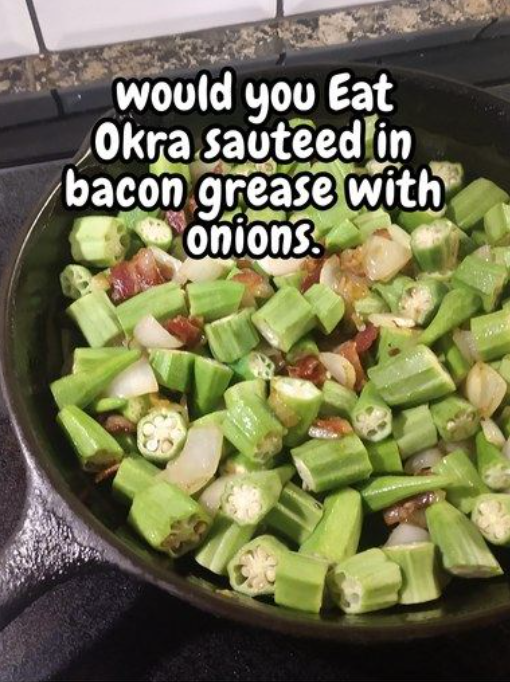
- **Prep Ingredients:** Slice the **fresh okra** into bite-sized pieces and chop the **onion** into thin slices.
- **Brown the Beef (TWO-STAGE PRINCIPLE, Stage 1):** In a large skillet, cook the **diced beef** until well browned on all sides. Remove the beef and set it aside.
- **Render Fat and Sauté Onions:** Leave a little of the **beef fat** in the pan (1–2 tablespoons is ideal). Add a touch of neutral oil if needed. Add the **onions** and sauté until golden and soft, scraping up the browned beef bits (fond) from the pan.
Phase 2: Sautéing the Okra
- **Add Okra (HIGH-HEAT EVAPORATION):** Increase the heat slightly to medium-high. Toss in the **sliced okra**.
- **Cook and Stir:** Cook the okra, stirring often, for **10–15 minutes**. The process is complete when the okra is fully tender and has achieved a **slight browning**, signifying the mucilage has broken down.
- **Season:** Season generously with **salt, black pepper, and the pinch of cayenne**. Toss to combine.
Phase 3: Finishing and Serving
- **Reintroduce Beef (REINTRODUCTION PROTOCOL):** Add the **cooked beef** back to the skillet. Mix well and cook for 1-2 minutes to reheat the beef and coat it thoroughly in the seasoned okra mixture.
- **Serve:** Serve warm with cornbread or rice for a hearty Southern-style side.
Serving and Storage: The Flavor of Fusion
Optimal handling for this savory dish:
- **Serving:** This dish is substantial enough to be a main course but shines as a side to simple poultry or fish. Serve hot for the best flavor and texture.
- **Storage:** Store fully cooled leftovers in an airtight container for up to **3 days** in the refrigerator.
- **Reheating:** Reheat in a **skillet** with a small amount of oil over medium-high heat to restore some of the seared texture. Avoid microwaving if possible.
Tips: Essential Techniques for Texture and Flavor
Okra Prep: Always **wash and thoroughly pat dry** the okra (Instruction 1) before slicing. Excess moisture is the enemy of a non-slimy sauté.
Beef Choice: Choose cuts like **brisket, round, or sirloin** that have been diced small (about $\frac{1}{2}\text{ inch}$ cubes) or cut into thin strips. This allows them to cook quickly and fully brown without requiring a long braise.
Cast Iron Advantage: Use a **cast iron skillet** (Instruction 2). Its superior heat retention is vital for searing both the beef (creating deep fond) and the okra (preventing sliminess).
Preventing Overcrowding: Cook the **beef in batches** if necessary, and use a wide enough pan so the okra is spread in a single, thin layer. Overcrowding drops the pan temperature, which leads to steaming and sliminess.
Sauté Time is Key: Do not rush the okra cooking time (Instruction 7). The $10\text{–}15\text{ minutes}$ is required to cook off the released moisture and neutralize the mucilage.
Variations: Customizing Spices and Aromatics
Easily adapt the flavor profile of the dish:
- **Smoky Depth:** Add $\frac{1}{2}\text{ teaspoon}$ of **smoked paprika** along with the cayenne and other seasonings (Instruction 8).
- **Garlic Infusion:** Add **1 tablespoon of minced garlic** to the skillet after the onions have softened, cooking for 30 seconds before adding the okra (Instruction 4).
- **Southern Acid Finish:** For a subtle tang, add a **splash of apple cider vinegar** just before serving (Instruction 10). The acidity must be added *after* the okra is fully cooked to prevent texture issues.
- **Greens Boost:** Stir in **1 cup of chopped collard greens or kale** when adding the onions, allowing them to wilt down before the okra is introduced.
**Stirring the Okra:** Stir the okra frequently but gently (Instruction 7). You need to move the pieces around to ensure even cooking and browning, but stirring too aggressively can break the pieces and release more mucilage.
**Seasoning the Beef:** For maximum flavor, season the diced beef liberally with salt and pepper **before** browning (Instruction 2). This ensures the protein itself is flavorful before the sauté begins.
**Oily Correction:** If, after the onions are done (Instruction 4), the pan looks dry, add a **teaspoon of neutral oil** (canola, vegetable, or peanut) to ensure there is enough fat for the high-heat sear the okra requires.
**No Water or Broth:** Do not add any liquids (water or broth) during the okra cooking process (Instruction 7). Any liquid will drop the pan temperature and encourage sliminess.
Conclusion: A Lesson in Heat and Time
The **Sautéed Okra with Beef** is a culinary success story that relies on technique over complexity. By adhering to **The Two-Stage Browning Principle** to maximize umami, strictly following **The High-Heat Moisture Evaporation Rule** to achieve perfect texture, and using **The Beef Reintroduction Protocol** for protein integrity, you create a rustic, hearty, and deeply satisfying Southern meal. It is a powerful combination of lean meat and perfectly prepared fresh vegetable.
Frequently Asked Questions (FAQ)
Q: Why did my okra still turn slimy?
A: The most common causes are **not patting the okra dry** before slicing, **overcrowding the pan** (which lowers the heat), or **not cooking it long enough** to achieve slight browning (Instruction 7).
Q: Can I use ground beef instead of diced beef?
A: **Yes**, ground beef works well. Cook it until crumbled and well-browned, drain off the excess grease, and follow the same reintroduction protocol (Instruction 3 & 10).
Q: What if I don’t have enough beef fat left in the pan?
A: Supplement the fat with a neutral, high-heat oil like **canola, peanut, or vegetable oil** until you have approximately 1–2 tablespoons of fat remaining (Instruction 4). This ensures a good sear for the okra.
Q: Can I use frozen okra?
A: **Yes**, you can use frozen okra, but do not thaw it first, as thawing releases too much moisture. Add it directly to the hot pan and expect a slightly longer cooking time initially while the moisture evaporates.