ADVERTISEMENT
Phase 1: Stovetop Flavor Building
- **Sauté Beef (SEAR AND DRAIN IMPERATIVE):** In a large skillet, brown the **ground beef** over medium-high heat until no pink remains. **Drain off all excess grease** and transfer the beef to the slow cooker insert.
- **Sauté Onion (Optional):** In the same skillet (or directly in the slow cooker if using a sear-capable model), sauté the **diced onion** for $5\text{ minutes}$ until softened and translucent. Add to the slow cooker with the beef.
Phase 2: Slow Cooker Assembly and Cooking
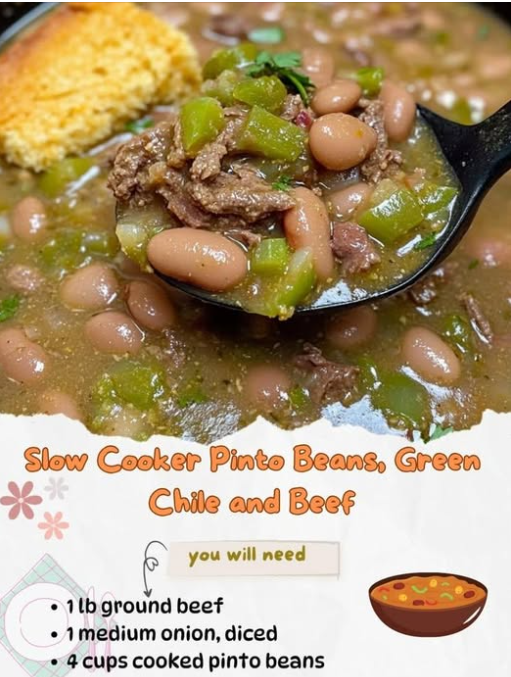
- **Add Beans and Tomatoes:** Add the **cooked pinto beans** (drained/rinsed if canned), the **diced tomatoes with green chilies** (undrained), and the small can of **diced green chilies** (undrained) to the slow cooker.
- **Add Liquid and Seasoning:** Pour in the **2 cups of beef broth**. Sprinkle in the **1 teaspoon of chili powder**. Stir everything gently to combine.
- **Cook (FLAVOR INFUSION PROTOCOL):** Cover and cook on **LOW for 6 to 8 hours** or on **HIGH for 3 to 4 hours**.
- **Final Check and Serve:** Stir the stew. If desired, mash a few of the pinto beans against the side of the insert for extra thickness. Taste and adjust seasoning with salt and pepper. Serve warm.
Serving and Storage: Maximizing Richness
Optimal handling for this hearty stew:
- **Serving Suggestions:** This dish is traditionally served with **rice or cornbread**. Top with sour cream, shredded cheese, and fresh cilantro for added texture and flavor contrast.
- **Storage:** Store leftovers in an airtight container in the refrigerator for up to **4 days**.
- **Freezing:** This stew freezes exceptionally well. Cool completely, transfer to freezer-safe containers, and freeze for up to **3 months**. Thaw overnight and reheat gently.
Tips: Essential Techniques for Thickness and Depth
Rinsing the Beans: If using canned pinto beans (Ingredient II), **always drain and rinse them well**. This removes excess sodium and the thick, unappetizing liquid the beans are packed in.
Boosting Umami: Before browning the beef (Instruction 1), season it well with salt and pepper. To deepen the savory crust, add **$\frac{1}{2}\text{ teaspoon}$ of smoked paprika** to the beef while it browns.
Thickening Trick: If the stew is too thin after cooking (Instruction 6), remove about $\frac{1}{2}\text{ cup}$ of the stew, mash the contents thoroughly, and return it to the slow cooker. This utilizes the **Bean Starch Thickening Rule** without using external thickeners.
Vegetable Consistency: If you are using very lean ground beef, you may need to add $\frac{1}{2}\text{ tablespoon}$ of olive oil to the skillet when browning the onion (Instruction 2) to prevent it from sticking and burning.
Spice Bloom: To maximize the flavor of the chili powder (Ingredient III), stir it into the sautéed onions (Instruction 2) for $30\text{ seconds}$ before adding the mixture to the slow cooker. This process, called “blooming,” intensifies the spice flavor.
Variations: Customizing Heat and Texture
Easily adapt the flavor profile of the stew:
- **Smoky Flavor:** Add **1 can ($15\text{ oz}$) of chipotle peppers in adobo sauce**, minced, along with the green chilies (Ingredient II). Start with $1\text{ teaspoon}$ of adobo sauce for controlled heat.
- **Protein Swap:** Substitute the ground beef (Ingredient I) with **ground turkey or shredded chicken** (cooked beforehand), following the same sear and drain imperative.
- **Herbaceous Notes:** Add **1 teaspoon of dried oregano** and a bay leaf to the stew alongside the chili powder for a more traditional chili profile.
- **Tangy Kick:** Stir in $1\text{ tablespoon}$ of **apple cider vinegar** or lime juice right before serving (Instruction 6) to brighten the stew’s overall flavor.
**Lid Off Rule:** To prevent excessive evaporation and heat loss during the long cooking time, **do not lift the slow cooker lid** (Instruction 5) until the end of the cooking period unless absolutely necessary. Every time the lid is opened, the heat drops significantly, adding up to $30\text{ minutes}$ to the cooking time.
**Pre-Cooking Aromatics:** While the slow cooker will cook the raw onion (Ingredient I), taking the $5\text{ minutes}$ to sauté it first (Instruction 2) deepens its flavor and prevents it from having a slightly raw taste in the finished product.
**Salt Control:** If using commercial beef broth and canned ingredients (Ingredient II/III), be cautious with added salt. Taste the final product *before* adding any extra salt (Instruction 6), as the canned items are often high in sodium.
**Liquid Level:** The **2 cups of beef broth** (Ingredient III) are enough because the liquid from the can of diced tomatoes with green chilies is also included. The stew should be thick, not soupy.
Conclusion: The Reward of Patience
The **Slow Cooker Pinto Beans, Green Chile, and Beef** is a perfect example of set-it-and-forget-it cooking, yielding maximum comfort and depth of flavor with minimal active time. By prioritizing **The Sear and Drain Imperative** to build a rich base and trusting **The Low and Slow Flavor Infusion Protocol** to blend the bold Tex-Mex notes, you achieve a thick, flavorful, and truly satisfying meal ready after a patient simmer.
Frequently Asked Questions (FAQ)
Q: Can I use dried pinto beans instead of canned?
A: **Yes**, but they must be soaked and cooked *before* adding them to the slow cooker mixture (Ingredient II), as the cooking time for dried beans is much longer than the recipe’s total cook time.
Q: My stew is too watery. What can I do?
A: Remove the lid for the last hour of cooking on HIGH (Instruction 5). This allows some moisture to evaporate. Alternatively, mash some of the pinto beans (Tip 6) for a rapid thickening effect.
Q: Can I put raw ground beef directly into the slow cooker?
A: **It is not recommended.** You risk introducing excessive grease and missing the vital, rich flavor developed by the browning process (The Sear and Drain Imperative, Instruction 1).
Q: What size slow cooker is needed?
A: A $4\text{ to }6\text{ quart}$ slow cooker is ideal for this recipe size.
ADVERTISEMENT