ADVERTISEMENT
Phase 1: Prep and Scalding
- **Prep:** Preheat oven to **$325^\circ\text{F}$ ($160^\circ\text{C}$)**. Lightly prick the bottom of the **pie shell** with a fork to prevent bubbling, or prepare a foil collar around the crust edge to prevent burning. Place the crust on a baking sheet.
- **Scald Dairy:** In a saucepan, combine the **whole milk, heavy cream, and half of the sugar** ($\frac{1}{4}\text{ cup}$). Heat over medium-low heat, stirring occasionally, until the mixture is **scalded** (small bubbles form around the edges). Do not boil. Remove from heat and stir in the **vanilla extract and salt**.
Phase 2: Tempering and Baking (Coagulation Mandate)
- **Temper Eggs (EMULSION PROTOCOL):** In a large bowl, whisk the **eggs, remaining sugar** ($\frac{1}{4}\text{ cup}$), **cornstarch (if using), and $\frac{1}{4}\text{ tsp}$ of the cinnamon** until pale and frothy. Slowly ladle about **$1\text{ cup}$ of the hot milk mixture** into the egg mixture, whisking constantly and rapidly. This ensures the eggs do not scramble.
- **Combine and Strain:** Pour the tempered egg mixture back into the remaining warm milk mixture. Whisk gently until just combined. **Strain the entire custard mixture** through a fine-mesh sieve into a clean bowl. This removes any possible egg clumps or air bubbles.
- **Bake:** Pour the strained custard carefully into the unbaked pie crust. Sprinkle the top lightly with the remaining **cinnamon** and the **nutmeg**. Bake at **$325^\circ\text{F}$** for **$45\text{–}60\text{ minutes}$**. The pie is done when the edges are set and a $1\text{–}2\text{-inch}$ radius in the center still has a slight, soft **wobble** (STRUCTURAL SET PRINCIPLE).
Phase 3: Cooling and Serving
- **Cooling:** Remove the pie from the oven and let it cool completely on a wire rack for at least **$2\text{ hours}$**. The residual heat will finish setting the center.
- **Chill and Serve:** Refrigerate the pie for at least **$4\text{ hours}$** (or overnight) before slicing. Custard pie must be served cold for the best stability and texture.
Tips: Essential Techniques for Smoothness
Preventing the Soggy Bottom: While a full blind bake is not required, lining the pie shell with aluminum foil and baking for $10\text{ minutes}$ with pie weights can help **par-bake the crust** bottom, ensuring it doesn’t become saturated and soggy during the long bake time.
The Temperature Check: For technical perfection, the pie is finished when a thermometer inserted near the edge registers $170^\circ\text{F}$ to $175^\circ\text{F}$. Above $180^\circ\text{F}$ the proteins will **over-coagulate** and weep (curdle).
The Cornstarch Insurance: Adding a teaspoon of **cornstarch** (Ingredient II) acts as a stabilizing starch. It binds moisture and helps prevent the milk and eggs from separating (weeping) during the chilling process, which often leads to a grainy texture.
Aromatic Infusion: For a deeper flavor, you can add a piece of **whole cinnamon stick** to the milk/cream mixture during the scalding process (Instruction 2). Remove the stick before tempering the eggs.
Serving Temperature: Do not serve this pie warm (Instruction 7). The structure only achieves its full, clean set after it has been thoroughly **chilled** in the refrigerator. Slicing too early will result in a runny slice.
Variations: Customizing Flavor and Crust
Easily adapt the flavor profile of the classic pie:
- **Nutmeg Emphasis:** Increase the **nutmeg** on top to $\frac{1}{2}\text{ tsp}$ and mix a dash of nutmeg into the custard filling as well for a stronger classic eggnog-like flavor.
- **Ricotta Cream:** For an even richer texture, substitute $\frac{1}{2}\text{ cup}$ of the whole milk with $\frac{1}{2}\text{ cup}$ of **smooth, whole-milk ricotta cheese**, whisked until lump-free.
- **Rum or Bourbon:** Add $1\text{ tbsp}$ of **dark rum or bourbon** along with the vanilla extract to the scalded dairy for a deeper, warming holiday note.
- **Coconut Crust:** Use a **graham cracker or vanilla wafer crust** instead of a traditional pastry crust for a contrasting texture and flavor base.
Conclusion: A Precise and Rewarding Bake
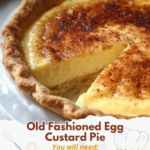
The **Old Fashioned Custard Pie** is a precise bake that demands patience and respect for heat. By diligently executing **The Tempering and Emulsion Protocol** and trusting **The Gentle Protein Coagulation Mandate** during the low-and-slow bake, you ensure a flawless, velvety custard. This recipe offers a deeply satisfying, classic dessert that is simple in ingredients but complex in its perfect texture.
Frequently Asked Questions (FAQ)
Q: Why did my custard crack down the center?
A: Cracking occurs due to **overbaking** (Instruction 5). The edges set and shrink while the still-soft center continues to cook, pulling the surface apart. Use the **jiggle test** (Instruction 5) and remove the pie promptly!
Q: My custard looks grainy and watery. What happened?
A: This is evidence of **curdling** and **weeping**. The most common causes are either **improper tempering** (the eggs scrambled when added to the hot milk) or **overbaking** (the high heat caused the proteins to seize and expel moisture).
Q: Can I use low-fat milk?
A: **Not recommended**. The high fat content from the whole milk and heavy cream is essential for flavor, texture, and stability. Lower fat content makes the mixture more prone to curdling and a thinner, less rich final custard.
Q: Should I cover the pie while baking?
A: If the crust edges begin to brown too quickly, loosely covering the pie with a **foil tent** (leaving a small vent) can prevent the top from over-browning while the center finishes cooking. This can also help prevent the top from forming a skin.
ADVERTISEMENT