
Miniature Masterpiece: The Inverted Science of Pineapple Upside-Down Cupcakes 🍍🍒
The **Pineapple Upside-Down Cupcake** is a scaled-down, portion-controlled version of the classic cake, distinguished by its unique construction method: baking the caramelized topping **beneath** the batter. The success of this technique relies entirely on the creation of a stable, non-sticky caramelized base that, when inverted, separates cleanly from the pan and adheres perfectly to the cake. The topping layer is a calculated mixture of $\mathbf{\frac{1}{4} \text{ cup of melted unsalted butter}}$ and $\mathbf{\frac{1}{2} \text{ cup of packed brown sugar}}$. The molasses in the brown sugar contributes deep color and moisture, leading to a softer, less brittle caramel than if granulated sugar were used.
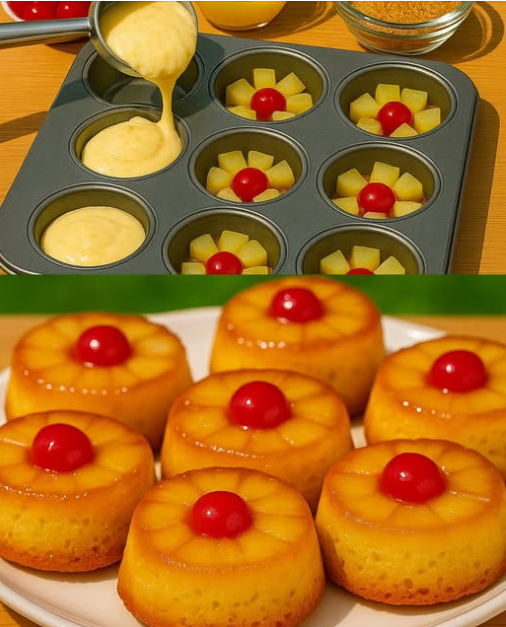
Crucially, the **topping layer is placed directly into the muffin cups first** (Step 1), followed by the decorative **pineapple and cherry pieces** (Step 2). When baked at $\mathbf{350^{\circ}\text{F}}$, the brown sugar-butter mixture melts, caramelizes slightly, and permeates the bottom layer of the $\mathbf{1 \frac{1}{2} \text{ cup flour}}$ cake batter. The $\mathbf{1 \frac{1}{2} \text{ teaspoons of baking powder}}$ in the batter provides the lift necessary to float the pineapple and cherry pieces without fully submerging them, ensuring they remain visible upon inversion. The high acidity of the pineapple naturally tenderizes the portion of the cake it touches, leading to an incredibly moist and flavorful surface when the cupcake is flipped. This inversion technique effectively steams the fruit, locking in moisture and creating a glossy, fruity glaze.
Introduction: Caramelization Chemistry and Inversion Mechanics
This dessert is a study in thermal and mechanical processes—how heat creates flavor and how gravity ensures the final form.
Caramelization and Flavor Depth
The **brown sugar** is vital for the caramelization process. When heated, the sugar molecules undergo complex non-enzymatic browning reactions. Brown sugar contains molasses, a source of fructose and glucose, which caramelize at lower temperatures ($\approx \mathbf{320^{\circ}\text{F}}$) than pure sucrose. This lower temperature caramelization, combined with the presence of $\mathbf{\frac{1}{4} \text{ cup of melted butter}}$, creates a rich, fudgy sauce that stays soft and sticky, which is crucial for the coating to adhere to the cake rather than harden and stick to the muffin tin.
The Importance of Quick Inversion
The inversion of the cupcakes is a mechanical step that must be timed perfectly. The cupcakes must be removed from the pan while **still warm** (Step 8). If allowed to cool completely, the $\mathbf{brown \text{ sugar}}$ caramel will set and solidify, creating a firm bond between the caramel and the tin, preventing a clean release. Inverting while warm allows the slightly molten caramel to detach and wick onto the newly exposed surface of the cake, forming the signature glossy glaze.
