The ingredients are selected to produce a tender crumb that can withstand the weight of the fruit and the moisture of the caramel.
| Component | Quantity | Functional Role and Technical Insight |
|---|---|---|
| **Topping Structure (Non-Stick Caramel)** | ||
| **Brown Sugar, packed** | $\frac{1}{2}$ cup | **Soft Caramel:** Molasses content prevents a brittle, hard caramel, ensuring a sticky glaze upon inversion. |
| **Unsalted Butter, melted** | $\frac{1}{4}$ cup | **Release Agent:** Coats the muffin tin, facilitating clean separation after baking. |
| **Cake Structure (Crumb and Lift)** | ||
| **Unsalted Butter, softened ($\frac{1}{2}$ cup)** and **Granulated Sugar ($\frac{3}{4}$ cup)** | Creamed | **Aeration:** Provides the mechanical lift and fat necessary for a tender, velvety crumb texture. |
| **Baking Powder** | $1 \frac{1}{2}$ tsp | **Chemical Leavening:** The primary source of rise, crucial for lifting the heavy topping. |
| **Pineapple Pieces** | 12 small pieces | **Acidity/Moisture:** High acidity tenderizes the cake crumb it touches; provides flavor and moisture. |
Instructions: The Inversion Protocol and Thermal Control
The instructions meticulously follow the inverted assembly and the critical steps for successful demolding.
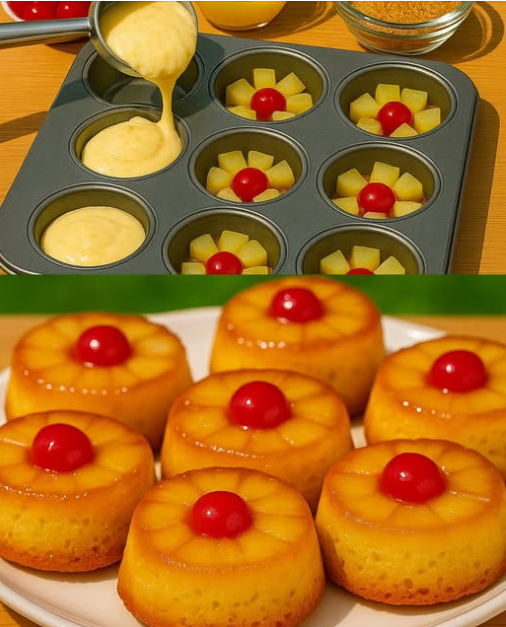
- **Pre-Topping Assembly:** Preheat oven to $\mathbf{350^{\circ}\text{F}}$ ($\mathbf{175^{\circ}\text{C}}$). Pour the $\mathbf{\frac{1}{4} \text{ cup of melted butter}}$ evenly into the bottom of the $\mathbf{12 \text{ muffin cups}}$. Do not use liners; the caramel must contact the metal.
- **Caramel Base:** Sprinkle the $\mathbf{\frac{1}{2} \text{ cup of packed brown sugar}}$ evenly over the butter in the muffin cups. This mixture will form the caramel. Place $\mathbf{1 \text{ small pineapple piece}}$ on top of the sugar in each cup, followed by $\mathbf{\frac{1}{2} \text{ maraschino cherry}}$ in the center of the pineapple.
- **Dry Ingredients:** Whisk together the $\mathbf{1 \frac{1}{2} \text{ cups of flour}}$, $\mathbf{1 \frac{1}{2} \text{ tsp baking powder}}$, and $\mathbf{\frac{1}{4} \text{ tsp salt}}$. Set aside.
- **Creaming:** In a separate bowl, cream the $\mathbf{\frac{1}{2} \text{ cup of softened butter}}$ and $\mathbf{\frac{3}{4} \text{ cup of granulated sugar}}$ until light and fluffy ($\mathbf{3 \text{ to } 4 \text{ minutes}}$), ensuring maximum air incorporation.
- **Wet Mixture:** Beat in the $\mathbf{1 \text{ large egg}}$ and $\mathbf{1 \text{ tsp vanilla extract}}$.
- **Mixing:** Alternate adding the dry mixture and the $\mathbf{\frac{1}{2} \text{ cup of milk}}$ to the wet ingredients, beginning and ending with the dry mixture. Mix only until just combined; **do not overmix** to prevent a tough cupcake.
- **Bake:** Spoon the batter evenly over the pineapple/caramel layer in the prepared muffin tin, filling cups about $\mathbf{\frac{2}{3}}$ full. Bake for $\mathbf{20 \text{ to } 25 \text{ minutes}}$, or until a toothpick inserted into the cake portion comes out clean.
- **Critical Inversion:** Immediately upon removal from the oven, allow the cupcakes to cool in the pan for only $\mathbf{2 \text{ to } 3 \text{ minutes}}$. Place a flat cooling rack over the muffin tin and, in one swift motion, **invert the entire tin**. Gently lift the tin, leaving the cupcakes (and the caramel topping) on the rack. If any caramel remains in the tin, use a small spoon to scrape it onto the corresponding cupcake.
- **Cool Completely:** Allow the inverted cupcakes to cool completely on the rack before serving.
Serving and Storage: The Moisture Challenge
Optimal Serving and Presentation
The cupcakes should be served at room temperature to allow the full aromatic impact of the caramel and pineapple to emerge. Serving them too cold mutes the flavor.
- **Garnish:** No frosting is needed due to the caramelized topping, but a simple dollop of $\mathbf{\text{whipped cream}}$ or a small scoop of vanilla bean ice cream complements the rich sweetness.
- **Display:** Display the cupcakes face-up (inverted side visible) to showcase the glossy, fruit-studded topping.
Storage and Longevity
The high moisture content of the caramel and fruit necessitates careful storage.
- **Room Temperature (Short Term):** Store in an airtight container for up to $\mathbf{2 \text{ days}}$. However, the fruit moisture will migrate into the cake, softening the base.
- **Refrigeration (Best Option):** Store in the refrigerator for up to $\mathbf{5 \text{ days}}$. Always store them in a single layer to prevent the sticky topping from adhering to the container lid or other cupcakes. Bring them to room temperature for about 30 minutes before serving.
- **Freezing:** Freezing is **not recommended** for upside-down cakes. The high moisture content of the caramelized fruit topping often leads to separation and a watery, mushy texture upon thawing.
Tips: Guaranteeing the Non-Stick Inversion
Tip: The Acidity Factor
Pineapple contains the enzyme **bromelain**, a protease that breaks down protein. While baking deactivates most bromelain, it contributes to the extreme tenderness of the cake where the fruit touches. To ensure maximum stability and clean inversion, make sure the $\mathbf{\frac{1}{2} \text{ cup of milk}}$ and $\mathbf{1 \text{ large egg}}$ are at **room temperature** before mixing, as this helps create a stronger, more stable emulsion in the batter.
Technical Pointers
- **Drying the Pineapple:** Before placing the $\mathbf{12 \text{ small pineapple pieces}}$ in the tin, pat them dry with a paper towel. Excess moisture from the fruit can interfere with the caramelization of the brown sugar, leading to a watery, sticky mess instead of a firm glaze.
- **Avoid Muffin Liners:** Do not use paper liners! The topping will stick to the paper rather than the cake, defeating the entire purpose of the upside-down format. The caramel needs direct contact with the heated metal tin for the non-stick release to work upon inversion.
- **Do Not Overfill:** Fill the muffin cups only about $\mathbf{\frac{2}{3} \text{ full}}$ with batter. Overfilling will cause the batter to spill over the topping during the rise, resulting in a mess and a very difficult inversion.
- **Clean Tin:** Ensure the muffin tin is perfectly clean before starting. Any residual grease or burned material can act as an anchor, causing the topping to stick permanently to the pan.
- **Use Brown Sugar:** While granulated sugar could be used, it yields a hard, brittle caramel that is much more likely to stick to the pan and crack the cake upon inversion. The moisture from the molasses in the $\mathbf{\frac{1}{2} \text{ cup of brown sugar}}$ is essential for the soft, gooey glaze.
Variations: Flavor Infusions and Topping Alternatives
The inverted cake method can be adapted easily by swapping the fruit and the flavoring agents.
Fruit and Flavor Swaps
- **Stone Fruit Delight:** Replace the pineapple with $\mathbf{\text{peaches or apricots}}$ (canned or frozen, thawed and dried). Add $\mathbf{\frac{1}{2} \text{ teaspoon of almond extract}}$ to the cake batter instead of vanilla.
- **Tropical Mango-Rum:** Substitute the pineapple with $\mathbf{\text{cubes of fresh mango}}$. Use $\mathbf{2 \text{ tablespoons of dark rum}}$ instead of $\mathbf{2 \text{ tablespoons of the milk}}$ in the batter, and add $\mathbf{\frac{1}{4} \text{ teaspoon of ground cardamom}}$ to the flour mixture.
- **Cranberry Orange:** Replace the pineapple with $\mathbf{\text{fresh or frozen cranberries}}$ and the cherries with $\mathbf{\text{orange slices}}$. Add $\mathbf{\frac{1}{2} \text{ teaspoon of orange zest}}$ to the cake batter.
Caramel Base Alterations
- **Darker Caramel:** Substitute the $\mathbf{\frac{1}{2} \text{ cup of brown sugar}}$ with $\mathbf{\frac{1}{2} \text{ cup of dark brown sugar}}$ for a richer, more molasses-heavy flavor.
- **Spice Infusion:** Add $\mathbf{\frac{1}{4} \text{ teaspoon of ground ginger}}$ and $\mathbf{\frac{1}{8} \text{ teaspoon of nutmeg}}$ to the brown sugar mixture before placing it in the muffin cups.
Tips: Maximizing Crumb Texture and Stability
Tip: High Altitude Adjustment
If baking at high altitude, the $\mathbf{1 \frac{1}{2} \text{ tsp of baking powder}}$ may cause the cupcakes to rise too quickly and collapse. Reduce the baking powder by $\mathbf{\frac{1}{4} \text{ teaspoon}}$ and increase the $\mathbf{1 \frac{1}{2} \text{ cups of flour}}$ by $\mathbf{2 \text{ tablespoons}}$ to stabilize the batter structure.
Baking Science Deep Dive
- **Room Temperature Emulsion:** Ensuring the $\mathbf{\frac{1}{2} \text{ cup of softened butter}}$, $\mathbf{1 \text{ large egg}}$, and $\mathbf{\frac{1}{2} \text{ cup of milk}}$ are all at room temperature before mixing is essential. Room temperature ingredients emulsify more effectively, creating a smoother batter that traps air better, resulting in a tender, high-volume cupcake.
- **The Final Check:** To check if the cake is done (Step 7), look for visual cues: the edges should pull slightly away from the tin, and the center should spring back when lightly touched. Relying only on the toothpick test can be unreliable near the moist topping layer.
- **Spoon and Level:** Always use the $\mathbf{spoon\text{-and-}level}$ method for measuring the $\mathbf{1 \frac{1}{2} \text{ cups of flour}}$. Scooping flour directly from the bag compacts it, resulting in too much flour, which will lead to a dry, dense crumb that struggles to lift the fruit.
- **Batch Control:** If your muffin tin is dark, reduce the oven temperature by $\mathbf{25^{\circ}\text{F}}$ to prevent the bottoms (which will become the top) from over-browning before the cake is fully cooked.
Conclusion: A Decadent Lesson in Inversion
The **Pineapple Upside-Down Cupcake** is a triumph of controlled inversion, transforming a simple vanilla cake into a visually stunning and intensely flavored dessert. The key to its success lies in the meticulous layering of the $\mathbf{brown \text{ sugar and butter}}$ base to form a stable, non-stick caramel, and the perfectly timed **warm inversion**. This process ensures the moisture and flavor from the fruit transfer seamlessly to the cake surface, resulting in a single-serving treat that is moist, tender, and beautifully glazed.
Frequently Asked Questions:
Q: Why did my topping stick to the bottom of the muffin tin?
A: The most common cause is **cooling too long** (Step 8). If the cupcakes cool completely, the caramel hardens and fuses to the metal tin. They must be inverted after only $\mathbf{2 \text{ to } 3 \text{ minutes}}$ while the caramel is still molten. Also, ensure the $\mathbf{\frac{1}{4} \text{ cup of melted butter}}$ was distributed evenly.
Q: Can I use fresh pineapple instead of canned?
A: **Canned pineapple is strongly recommended.** Fresh pineapple contains the enzyme **bromelain**, a potent protease that will break down the gluten and protein structure of the cake batter, causing the cake to be extremely soft, mushy, and potentially preventing it from rising properly. The canning process deactivates this enzyme.
Q: My cupcakes look very dark on the inverted top. Why?
A: The topping likely **over-caramelized**. This could be due to your oven running hot, or using a **dark-colored muffin tin**. Dark tins absorb heat faster than light ones, causing the sugar to burn. Try reducing the oven temperature by $\mathbf{25^{\circ}\text{F}}$ next time.
Q: Can I use oil instead of butter in the cake batter?
A: While oil provides excellent moisture, the **creaming method** (Step 4) requires the $\mathbf{\frac{1}{2} \text{ cup of softened butter}}$ to incorporate air. Using oil would result in a dense, less flavorful cupcake with less rise, as oil doesn’t trap air like solid butter does during creaming.