
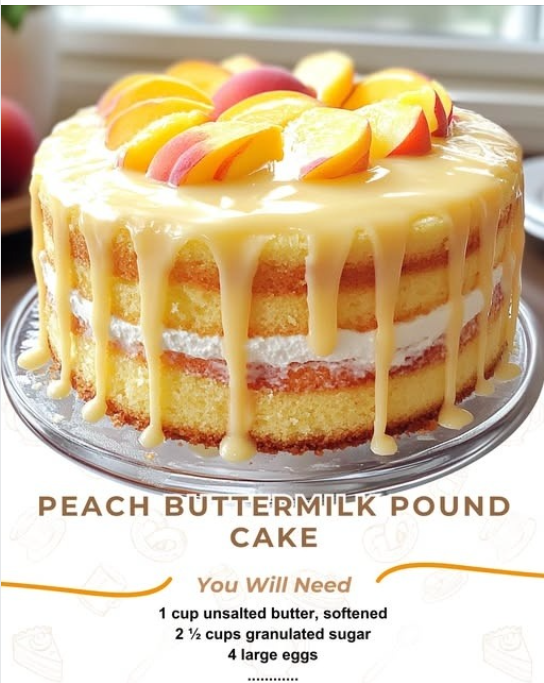
The Buttermilk Catalyst
Structural Tenderizing and Acid-Base Balancing in Peach Pound Cake
Introduction: The Science of Tenderization
In the culinary standards of 2026, the Peach Buttermilk Pound Cake is recognized as the ultimate expression of crumb tenderization. Unlike the dense “closed-cell” structure of a standard cream cheese pound cake, the introduction of buttermilk—a fermented dairy product with a low pH—initiates a process of protein denaturation. The lactic acid in the buttermilk works to weaken the gluten bonds in the flour, resulting in a cake that is remarkably soft while retaining the structural “heaviness” characteristic of a classic Southern pound cake.
The peach component acts as a high-moisture inclusion. In this specific iteration, we manage the hydrostatic pressure within the batter by balancing the fruit’s water content against the buttermilk’s acidity. This results in a cake that is aerated by the reaction between acid and leavening agents, yet remains lubricated by a rich butter-fat matrix.
Ingredients: The Molecular Components
Success in buttermilk-based cakes requires precise temperature control to ensure the emulsion does not “break” during the mixing phase.
- 1 Cup Unsalted Butter (Softened): Your primary lipid. It must be plastic enough to deform under the whisk but cold enough to hold air.
- 2 ½ Cups Granulated Sugar: The crystal geometry is used to “drill” air pockets into the butter.
- 4 Large Eggs: The protein binder. Eggs provide the structural “walls” for the air pockets created during creaming.
- Complementary Ingredients: Typically includes 3 cups of flour, 1 cup of buttermilk, 1/2 tsp baking soda (to react with the acid), and 2 cups of diced fresh peaches.
