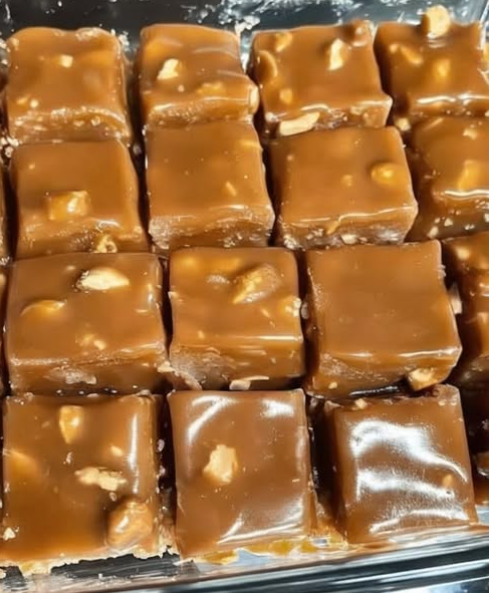
Every ingredient, even the tiny amount of baking soda, performs a key chemical or physical function.
| Component | Quantity | Functional Role and Technical Insight |
|---|---|---|
| **The Solute and Solvent** | ||
| **Sugar, divided** | 6 cups | **Primary Solute:** Provides structure. The concentration is managed by boiling off water content. |
| **Heavy Cream** | 2 cups | **Solvent & Interfering Agent:** Provides the necessary initial moisture; milk solids and fat inhibit crystallization. |
| **Controlling Texture and Flavor** | ||
| **Baking Soda** | $\frac{1}{4}$ teaspoon | **pH Regulator:** $\text{NaHCO}_3$ raises the pH, stabilizing the emulsion and preventing the cream from curdling under high heat. |
| **Unsalted Butter** | $\frac{1}{2}$ cup | **Shortening:** Adds rich flavor and ensures a tender (short) crystalline structure by coating sugar molecules. |
| **Nuts** | $1 \frac{1}{2}$ cups | **Seeding & Texture:** Act as nucleation sites during the final beating, promoting rapid micro-crystal formation. |
Instructions: Temperature Management and Nucleation
The instructions meticulously manage heat and physical force to control the phase transition from liquid syrup to solid fudge.
Kitchen Equipment Needed:
- Small saucepan (heavy-bottomed preferred)
- Large saucepan or Dutch oven
- Candy thermometer (calibrated)
- Whisk or wooden spoon
- 9×13-inch baking dish (greased or lined)
- Measuring cups and spoons
- **Initial Setup:** Lightly grease or line a $\mathbf{9 \times 13 \text{-inch baking dish}}$. Have the $\mathbf{1 \frac{1}{2} \text{ cups of chopped nuts}}$ and $\mathbf{1 \text{ tsp of vanilla extract}}$ ready.
- **Carmelization Base (Part 1):** In the small saucepan, melt $\mathbf{1 \text{ cup of the sugar}}$ over medium heat. Stir constantly until the sugar melts completely and turns a rich $\mathbf{\text{amber color}}$, indicating partial caramelization. Do not let it burn.
- **Combine Liquids:** Immediately add the $\mathbf{2 \text{ cups of heavy cream}}$ to the caramel. **Be extremely cautious; the mixture will bubble vigorously.** Stir until smooth.
- **Butter and Baking Soda:** Add the $\mathbf{\frac{1}{2} \text{ cup of butter}}$ and $\mathbf{\frac{1}{4} \text{ teaspoon of baking soda}}$ to the small saucepan mixture. Stir until the butter is melted and the baking soda is dissolved.
- **Create Syrup (Part 2):** In the large saucepan, combine the $\mathbf{\text{cream mixture}}$ from the small saucepan with the $\mathbf{\text{remaining } 5 \text{ cups of sugar}}$. Place the $\mathbf{\text{candy thermometer}}$ in the pan.
- **Boil:** Bring the mixture to a boil over medium-high heat. Stir constantly until the sugar is fully dissolved. Once boiling, reduce the heat slightly and **stop stirring** to prevent premature crystallization (or “graininess”).
- **Reach Soft-Ball Stage:** Cook until the mixture reaches exactly $\mathbf{240^{\circ}\text{F}}$ ($\mathbf{116^{\circ}\text{C}}$).
- **Cooling Protocol:** Immediately remove the large saucepan from the heat. **Do not scrape the bottom or sides of the pan.** Let the mixture stand undisturbed until it cools to $\mathbf{150^{\circ}\text{F}}$ ($\mathbf{65^{\circ}\text{C}}$). This slow, undisturbed cooling is critical for maximizing supersaturation.
- **Beating (Controlled Crystallization):** Once the syrup reaches $\mathbf{150^{\circ}\text{F}}$, add the $\mathbf{1 \text{ tsp vanilla extract}}$. Begin beating vigorously with a wooden spoon or whisk. Beat constantly until the mixture $\mathbf{\text{loses its gloss, thickens significantly, and turns opaque}}$ (about 5-10 minutes).
- **Incorporate Nuts:** Quickly stir in the $\mathbf{1 \frac{1}{2} \text{ cups of chopped nuts}}$. The nuts act as **nucleation sites**, encouraging rapid crystallization.
- **Set:** Pour the mixture immediately into the prepared $\mathbf{9 \times 13 \text{-inch baking dish}$. Do not scrape the pan. Let the candy cool completely at room temperature before cutting into squares.
Serving and Storage: Protecting the Micro-Crystal Structure
Optimal Presentation and Handling
The candy should be fully set before cutting, typically $\mathbf{2 \text{ to } 3 \text{ hours}}$ at room temperature.
- **Cutting:** Use a sharp, lightly greased knife to cut the candy into uniform $\mathbf{1 \text{-inch squares}$.
- **Serving Temperature:** Best served at room temperature. The high butter content ensures the flavor is maximized when not chilled.
Storage and Longevity
Proper storage is essential to prevent the candy from drying out or becoming sticky.
- **Room Temperature:** Store in an $\mathbf{\text{airtight container}}$ at room temperature for up to $\mathbf{2 \text{ weeks}}$. Separate layers with parchment paper to prevent sticking.
- **Refrigeration:** Refrigeration is **not recommended** as the moisture differences can cause the sugar to weep or become excessively hard.
- **Troubleshooting Stickiness:** If the humidity causes the candy surface to become sticky (a process called $\mathbf{\text{hygroscopicity}}$), try placing the cut pieces in a low oven ($\mathbf{200^{\circ}\text{F}}$) for $\mathbf{5 \text{ minutes}}$ to gently dry the surface.
Tips: Avoiding Graininess and Achieving Creaminess
Tip: Calibrate Your Thermometer
A misplaced $\mathbf{5^{\circ}\text{F}}$ in the cooking stage can ruin the entire batch. Check your $\mathbf{\text{candy thermometer}}$ by placing it in vigorously boiling water; it should read $\mathbf{212^{\circ}\text{F}}$ (or slightly lower, depending on altitude). Adjust your target temperature ($\mathbf{240^{\circ}\text{F}}$) accordingly.
Technical Pointers
- **Avoid Seeding:** After the initial boil (Step 6), **do not stir** the mixture. Any vibration, dust particle, or sugar crystal left on the side of the pan can act as a **seed crystal**, causing premature crystallization and resulting in a coarse, gritty candy. If crystals form on the sides, use a pastry brush dipped in water to wipe them down.
- **Heavy-Bottomed Pan:** The large pan should be $\mathbf{\text{heavy-bottomed}}$ to ensure heat is distributed evenly. Hot spots can cause sugar to scorch or caramelize unevenly, compromising the final flavor.
- **Baking Soda Action:** The $\mathbf{\frac{1}{4} \text{ teaspoon of baking soda}}$ helps neutralize potential acids in the cream. When the baking soda reacts with an acid, it releases $\text{CO}_2$ gas, which also helps aerate the mixture slightly during the final beating, contributing to a lighter texture.
- **Use Fresh Nuts:** Toasting the $\mathbf{1 \frac{1}{2} \text{ cups of nuts}}$ lightly before adding them enhances their flavor and aroma, contrasting beautifully with the sweet, creamy base.
Variations: Altering Interfering Agents and Flavors
The base recipe can be modified by introducing different interfering agents or flavorings.
Flavor and Extract Swaps
- **Maple Pecan:** Substitute the $\mathbf{5 \text{ cups of sugar}}$ in the large saucepan with $\mathbf{4 \text{ cups of sugar}}$ and $\mathbf{1 \text{ cup of high-quality maple syrup}}$. Use pecans as the nut base.
- **Chocolate Swirl:** Melt $\mathbf{2 \text{ ounces of unsweetened chocolate}}$ into the cream mixture (Step 3). Reduce the $\mathbf{\text{powdered sugar}}$ by $\mathbf{\frac{1}{4} \text{ cup}}$ to compensate for the bitterness.
- **Cinnamon Candy:** Add $\mathbf{1 \text{ teaspoon of ground cinnamon}}$ to the dry $\mathbf{\text{remaining } 5 \text{ cups of sugar}}$ before combining with the cream mixture (Step 5).
Textural Modifications
- **Chewier Fudge:** Replace $\mathbf{1 \text{ cup of heavy cream}}$ with $\mathbf{1 \text{ cup of corn syrup}}$. Corn syrup is an $\mathbf{\text{invert sugar}}$, which is a superior interfering agent, almost guaranteeing a non-grainy, chewier texture.
- **Mocha Twist:** Dissolve $\mathbf{1 \text{ tablespoon of instant coffee granules}}$ in the $\mathbf{2 \text{ cups of heavy cream}}$ before starting the process (Step 3).
Tips: Advanced Techniques for Supersaturation
Tip: The Undisturbed Cool
The period between $\mathbf{240^{\circ}\text{F}}$ and $\mathbf{150^{\circ}\text{F}}$ (Step 8) is the **supersaturation phase**. Do not bump the pan, move it, or scrape the sides. Any physical disturbance provides a $\mathbf{\text{nucleation point}}$ where large, uncontrolled crystals can start forming, leading to a grainy final product. Patience during cooling guarantees a smooth finish.
Confectionery Science Deep Dive
- **Altitude Adjustment:** At high altitudes, water boils at a lower temperature. The target temperature ($\mathbf{240^{\circ}\text{F}}$) must be lowered by $\mathbf{2^{\circ}\text{F}}$ for every $\mathbf{1,000 \text{ feet}}$ above sea level to account for the reduced atmospheric pressure.
- **Final Beating:** The beating step (Step 9) should be vigorous but stopped precisely when the candy loses its gloss. Over-beating will make the fudge $\mathbf{\text{too stiff and crumbly}}$ and difficult to pour, preventing the formation of a flat slab.
- **The Cream’s Role:** The high fat content of the $\mathbf{2 \text{ cups of heavy cream}}$ physically separates the sugar crystals, acting as a lubricant. The protein (casein) in the cream also stabilizes the syrup, making it less prone to scorching.
- **Caramel Base:** The initial caramelization of $\mathbf{1 \text{ cup of sugar}}$ (Step 2) is done to add complexity, depth, and a slight bitterness to balance the extreme sweetness of the final product.
Conclusion: A Decadent Lesson in Thermal Control
The **Oklahoma Nut Candy** recipe is a perfect lesson in controlled crystallization. Its successful execution depends on the accurate measurement of temperature to achieve the **Soft-Ball Stage** ($\mathbf{240^{\circ}\text{F}}$) and the strategic use of $\mathbf{\text{fat and milk solids}}$ as interfering agents. The final beating step is the precise moment of transformation, where the rapid, forced aggregation of thousands of tiny sugar crystals delivers the signature smooth, melt-in-your-mouth texture. This confection proves that mastering temperature and patience is the true secret to making creamy, non-grainy candy.
Frequently Asked Questions:
Q: Why did my candy turn out grainy instead of smooth?
A: Graininess occurs when **large, uncontrolled sugar crystals** form. This is usually due to: 1) $\mathbf{\text{Stirring the syrup}}$ after it reached boiling (Step 6), or 2) $\mathbf{\text{Disturbing the pan}}$ during the critical cooling phase ($\mathbf{240^{\circ}\text{F}}$ to $\mathbf{150^{\circ}\text{F}}$). Any premature crystal acts as a seed for rapid, large-crystal growth.
Q: My candy is too soft/runny. What did I do wrong?
A: The mixture was **not cooked to a high enough temperature** (Step 7). If the temperature falls below $\mathbf{235^{\circ}\text{F}}$, too much water remains, preventing the solution from becoming sufficiently supersaturated. The result is a sticky, overly soft texture.
Q: Can I use light cream or half-and-half?
A: **No.** You must use $\mathbf{2 \text{ cups of heavy cream}}$ (high fat content). The fat is a crucial interfering agent that prevents large crystal formation and provides the necessary richness. Lower-fat dairy will compromise the final texture and increase the risk of graininess.
Q: Why is the baking soda necessary?
A: The $\mathbf{\frac{1}{4} \text{ teaspoon of baking soda}}$ helps to neutralize any slight acidity from the cream or the caramelizing sugar. This pH regulation prevents the cream from curdling under high, sustained heat and aids in the smooth emulsification of the final mixture.