
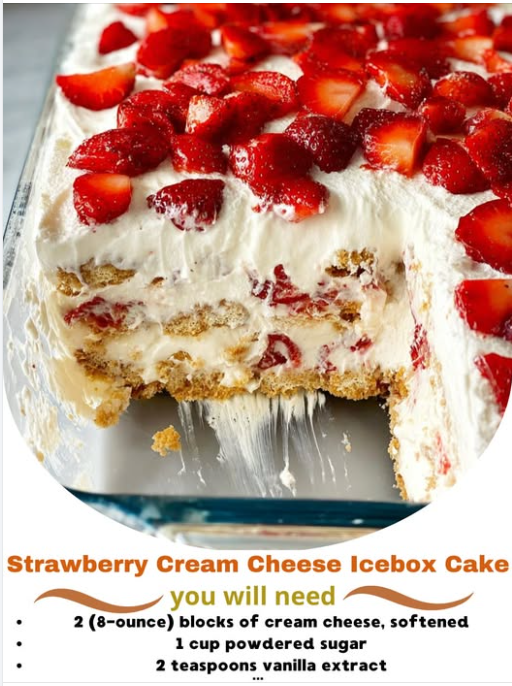
Strawberry Cream Cheese Icebox Cake: Mastering the No-Bake Art 🍓🍰
The **Icebox Cake** is an iconic American dessert characterized by its reliance on **time** rather than heat. This Strawberry Cream Cheese version transforms simple, dry **Graham crackers** into tender, cake-like layers through the process of **hydration**. The core mechanism involves a long chill period during which the crackers absorb moisture from the rich, dairy-based filling, losing their crunch and gaining a soft, cake-like consistency. The structure is built upon a sturdy, yet creamy, dairy base.
This specific recipe utilizes a **two-phase filling**—the $\mathbf{2 \text{ blocks of softened cream cheese}}$ mixed with $\mathbf{1 \text{ cup of powdered sugar}}$ provides the essential tangy, dense foundation, while **$\mathbf{1 \frac{1}{2} \text{ cups of whipped heavy cream}}$** is folded in to introduce necessary aeration and lightness. The tanginess of the cream cheese perfectly balances the sweetness of the sugar and the fresh, slight acidity of the **sliced strawberries**. The careful layering of these components ensures that every slice delivers the trifecta of flavor: the spongy texture of the softened cracker, the coolness and tang of the cheesecake filling, and the burst of fresh fruit. The final chilling time (minimum 6 hours) is non-negotiable; it is the catalyst that allows the chemical process of hydration to complete, turning a simple stack of cookies into an elegant “cake.”
Introduction: The Science of Icebox Hydration
The Icebox Cake is a technical marvel of no-bake confectionery, depending entirely on the physical property of **capillary action** and **moisture transfer**. The long, slow refrigeration process (the “icebox” step) is the equivalent of the oven in a baked cake, establishing the final texture.
The Starch Transformation
Graham crackers are primarily starch (flour) and sugar. When exposed to the high-moisture environment of the cream cheese/whipped cream filling, the cracker’s starches slowly absorb water through capillary action. This process, similar to the initial stage of gelatinization, weakens the cracker’s structural matrix, transforming the crisp, sandy texture into a soft, spongy consistency—the “cake” effect. The longer the chill time, the more complete this hydration process is, leading to a perfectly tender final product.
Emulsion Stability and Aeration
The filling is a stable **oil-in-water emulsion** (the cream cheese and whipped cream). The $\mathbf{2 \text{ blocks of cream cheese}}$ must be fully softened to ensure it creams smoothly with the **powdered sugar** and **vanilla**. The inclusion of **powdered sugar** (confectioners’ sugar) is critical because the small amount of cornstarch often added to it helps to stabilize the whipped cream component, preventing it from weeping (expelling water) during the long chill time. The whipped cream introduces essential air, making the final filling light enough to be layered without being overly dense, which would inhibit the cracker’s hydration.
