The ingredient list is highly precise, relying on the functional role of each component to ensure both structural integrity and the desired texture.
| Component | Quantity | Functional Role and Technical Insight |
|---|---|---|
| **The Foundation (Structure & Hydration Base)** | ||
| **Graham Crackers** | 30-36 sheets | **Starch Source:** Provides the matrix for hydration. The number required depends on the pan size. |
| **Fresh Strawberries** | 2-3 cups, sliced | **Moisture & Acidity:** Provides necessary moisture for cracker softening and a fresh, acidic counterpoint to the cream. |
| **The Cream Filling (Emulsion & Aeration)** | ||
| **Cream Cheese, softened** | 2 (8 oz) blocks | **Fat/Protein Base:** Creates a stable, tangy, and thick base filling. Room temperature is critical for smooth mixing. |
| **Powdered Sugar** | 1 cup | **Sweetener/Stabilizer:** Dissolves easily for smooth texture; cornstarch content aids in stabilizing the filling. |
| **Heavy Whipping Cream** | $1 \frac{1}{2}$ cups (cold) | **Aeration:** Must be cold to achieve maximum volume and stability when whipped to stiff peaks. |
Instructions: Layering for Uniformity
The assembly process is non-complex, but requires attention to layering technique to ensure structural integrity and uniform hydration.
- **Prep the Pan:** Line a $\mathbf{9 \times 13 \text{-inch or } 8 \times 8 \text{-inch baking dish}}$ with plastic wrap or parchment paper, leaving an overhang on the long sides. This “sling” is crucial for clean removal and slicing.
- **Whip the Cream (Aeration):** In a separate, cold bowl, beat the $\mathbf{1 \frac{1}{2} \text{ cups of cold heavy whipping cream}}$ (and optional $\mathbf{2 \text{ Tbsp of sweetener}}$) to stiff peaks. Set aside, keeping it cold.
- **Prepare the Cream Cheese Base (Emulsion):** In a large bowl, beat the $\mathbf{2 \text{ blocks of softened cream cheese}}$ until smooth. Beat in the $\mathbf{1 \text{ cup of powdered sugar}}$ and $\mathbf{2 \text{ tsp of vanilla extract}}$ until the mixture is light and creamy. **Ensure no lumps remain.**
- **Combine the Filling:** Gently fold the prepared **whipped cream** into the cream cheese mixture using a spatula. This folding technique minimizes air loss, maintaining the filling’s volume and lightness.
- **First Layer (Foundation):** Spread a thin layer of the cream mixture on the bottom of the prepared pan. This prevents the crackers from sticking and provides immediate moisture for the first layer.
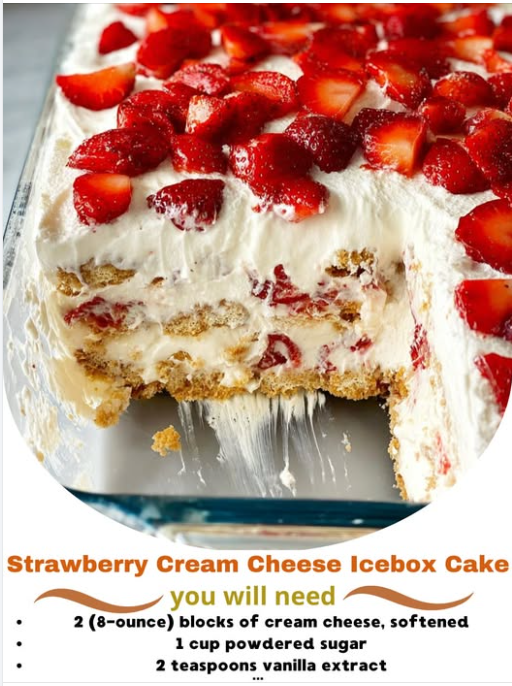
- **Cracker and Fruit Layers (Hydration):** Arrange a tight, single layer of **Graham crackers** over the cream base. Top the crackers with approximately $\mathbf{\frac{1}{3} \text{ of the cream filling}}$, spreading evenly. Arrange a layer of **sliced strawberries** over the cream. Repeat this process: **Crackers $\rightarrow$ Cream $\rightarrow$ Strawberries**. Aim for 3-4 cracker layers, ending with a layer of cream filling.
- **Seal and Chill (The Icebox Step):** Cover the cake tightly with the plastic wrap overhang and then plastic wrap directly on the surface to prevent a dry crust. Refrigerate for a **minimum of 6 hours**, but preferably **12 to 24 hours**. This time is essential for the crackers to fully soften.
- **Garnish and Serve:** Once set, lift the cake using the plastic wrap sling. Discard the wrapping. Garnish the top with the remaining **sliced strawberries** and, optionally, a light dusting of powdered sugar. Slice and serve cold.
Serving and Storage: The Importance of Cold
Optimal Serving Temperature
Icebox cake is designed to be served **cold**. Serving it immediately from the refrigerator ensures the filling is firm and stable, and the cake holds its clean, layered structure.
- **Slicing:** Use a long, sharp knife. For the cleanest slices, wipe the knife blade clean and dip it in warm water between each cut. This prevents the creamy filling from dragging and ruining the edge of the slice.
- **Garnish Timing:** Only garnish the cake **immediately before serving**. Freshly sliced strawberries can weep moisture, and if placed on the cake hours in advance, they can compromise the firmness of the top layer.
Storage and Longevity
Due to the dairy content, maintaining a cold temperature is essential for both food safety and texture.
- **Refrigeration:** Store any remaining cake, covered, in the refrigerator for up to **4 days**. The crackers will become increasingly soft over time, potentially leading to a slightly mushy, but still palatable, texture by day 4.
- **Freezing (Acceptable):** Icebox cake freezes surprisingly well due to the stabilizing effect of the high-fat cream cheese and sugar. Freeze the whole assembled cake, tightly wrapped, for up to **1 month**. Thaw overnight in the refrigerator. Note that the strawberries may be slightly softer after thawing, but the cake structure holds up well.
- **Preventing Drying:** Always cover the cake surface directly with plastic wrap when storing to prevent the top cream layer from drying out and developing a hard, unappealing crust.
Tips: Achieving the Perfect Filling and Structure
Tip: Cream Cheese Temperature
The most critical step is ensuring the **cream cheese is fully at room temperature** (softened) before mixing. Cold cream cheese will inevitably lead to lumps that cannot be fully smoothed out, compromising the silky texture of the final filling.
Technical Pointers
- **The Whipping Bowl:** To achieve the stiffest, most stable whipped cream (which is vital for structure), use a **very cold, metal mixing bowl and whisk attachment**. Chilling the equipment helps the fat globules stabilize the air bubbles faster and more effectively.
- **Preventing Soggy Bottoms:** Ensure the initial layer of cream on the bottom of the pan is a **thin, uniform layer**. An overly thick bottom layer can create an overly saturated, almost liquid bottom crust, leading to structural failure upon lifting.
- **Powdered Sugar Sifting:** Sift the **powdered sugar** before adding it to the cream cheese. Powdered sugar easily clumps, and sifting ensures the final filling is perfectly smooth and lump-free.
- **Optional Strawberry Enhancement:** For a moister final cake, briefly dip the Graham crackers into a thin layer of **strawberry purée or milk** before layering. This jumpstarts the hydration process, though it slightly increases the risk of mushiness if over-chilled.
Variations: Altering the Core Components
The basic cream cheese-whipped cream-cracker structure is a blank canvas for numerous flavor variations.
Fruit and Flavor Substitutions
- **Banana Pudding Icebox Cake:** Substitute the sliced strawberries with **sliced bananas**. Layer the crackers with vanilla wafers and mix a small amount of **vanilla pudding mix** (dry, for stabilization) into the cream cheese base.
- **Key Lime Icebox Cake:** Introduce $\mathbf{2 \text{ tablespoons of fresh key lime juice}}$ and $\mathbf{1 \text{ tablespoon of lime zest}}$ to the cream cheese base. Use **lime slices** for the fruit layer and garnish with toasted coconut.
- **Chocolate Raspberry:** Substitute the Graham crackers with **chocolate wafer cookies** (like Nabisco Wafers). Substitute the strawberries with fresh **raspberries**. Drizzle a thin layer of chocolate ganache over the top cream layer before chilling.
Cracker and Cream Adjustments
- **Salty-Sweet Base:** Replace the Graham crackers with **pretzels or vanilla sandwich cookies**. The salty-sweet contrast provides a more complex flavor profile.
- **Higher Stability Cream:** For tropical climates or very long chilling times, substitute $\mathbf{\frac{1}{2} \text{ cup of the heavy cream}}$ with **sweetened condensed milk**. The condensed milk provides structure, sweetness, and a higher fat content, making the filling more stable against weeping.
Tips: Advanced Structural Management
Tip: The Sturdier Pan
While a $9 \times 13 \text{-inch pan}$ is standard, using an $\mathbf{8 \times 8 \text{-inch pan}}$ will result in a much **thicker, taller cake**. This thickness ensures the cake holds its shape better and the layers are more visually distinct, but it requires a slightly longer chilling time (at least 18 hours).
Troubleshooting and Technique
- **Filling is Grainy/Lumpy:** This is almost always due to **cold cream cheese**. If the cream cheese lumps occur, stop mixing and let the entire mixture sit at room temperature for 15 minutes. Then, beat on high speed until smooth before folding in the whipped cream.
- **Filling Wept/Became Watery:** If the filling expelled liquid after chilling, the **whipped cream was not stable** enough or the final cake was not covered properly. Ensure the cream is whipped to true **stiff peaks** and that powdered sugar (stabilizer) is used.
- **Crackers Not Softening:** If the crackers are still crisp after 6 hours, the cake needs more time. This failure is often caused by a **filling that is too dry** (not enough liquid in the cream cheese base) or the cream being over-whipped to the point where it contained too little moisture.
- **For the Cheesecake Purist:** For an extra tangy kick, add $\mathbf{1 \text{ teaspoon of fresh lemon juice}}$ to the cream cheese mixture along with the vanilla. The acidity brightens the flavor profile considerably.
Conclusion: A Decadent Lesson in Emulsion
The **Strawberry Cream Cheese Icebox Cake** is a technical masterwork of no-bake desserts. Its success is entirely dependent on controlling the dairy emulsion’s stability and allowing sufficient time for the **hydration of the starch matrix**. The result is a multi-layered cake defined by its luscious, tangy cream cheese filling, its light aeration from the whipped cream, and the delightful textural transformation of the Graham cracker. It proves that culinary excellence can be achieved not through high heat and complex techniques, but through patient refrigeration and precise ingredient ratios, delivering a cool, decadent, and refreshing experience.
Frequently Asked Questions:
Q: Can I use low-fat cream cheese?
A: **It is not recommended.** Full-fat cream cheese provides the necessary fat and protein structure required to emulsify the filling and prevent separation or weeping during the long chill time. Low-fat versions often contain more water, which can lead to a softer, less stable final cake.
Q: Do I need to soak the Graham crackers before layering?
A: **No.** The crackers absorb moisture directly from the rich cream cheese filling and the fresh strawberries. Pre-soaking is unnecessary and greatly increases the risk of the final cake becoming mushy or structurally weak.
Q: Why did my whipped cream collapse when I folded it in?
A: The whipped cream was likely **over-whipped** (turning slightly granular and losing air) or the **cream cheese base was too cold or too dense**. The folding motion must be gentle to retain the air incorporated into the cream.
Q: How long is the absolute minimum chill time?
A: The **absolute minimum is 6 hours**, but to achieve a true cake-like consistency where the layers cut cleanly, **12 hours** is strongly recommended. Shorter times will result in crisp, crunchy cracker layers.