
The Alchemy of Red Velvet Crinkles: Science of Color, Chew, and Contrast 🔴🤍
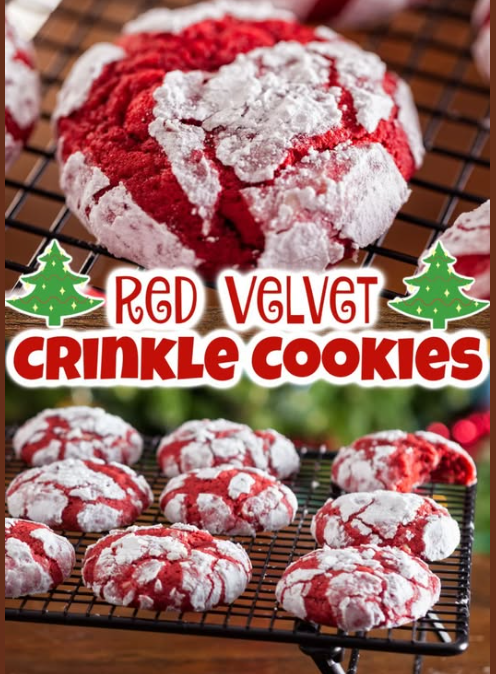
The **Red Velvet Crinkle Cookie** is a masterful study in sensory contrast, balancing visual drama with a nuanced flavor profile. The core of this cookie is a **tender, slightly acidic, cocoa-flavored dough**—the signature “velvet” texture. Unlike traditional chocolate cookies, the incorporation of only $\frac{1}{4} \text{ cup of unsweetened cocoa powder}$ allows the vanilla and buttermilk notes (though milk is used here, the overall profile is adapted from the classic cake) to dominate, rather than pure chocolate bitterness. The generous $5 \text{ teaspoons of red food coloring}$ ensures the vibrant, deeply saturated hue that gives the cookie its name and theatrical appearance.
The defining characteristic, the **crinkle effect**, is achieved through a specific coating process. The dough balls are rolled thoroughly in **powdered sugar** before baking. As the cookie dough rapidly expands during the baking process—driven by the $2 \text{ teaspoons of baking powder}$ and $\frac{1}{4} \text{ teaspoon of baking soda}$—the surface bursts through the insulating layer of powdered sugar. The sugar remains white and intact in the crevices, creating a beautiful, cracked, black-and-white contrast against the deep red interior. The large amount of fat ($\frac{3}{4} \text{ cup butter}$) combined with the sugar content ($1 \frac{1}{3} \text{ cups}$) ensures the cookie spreads sufficiently and maintains a desirable soft-chewy interior.
Introduction: The Chemistry of Color and Texture
The Red Velvet Crinkle Cookie is less about chocolate and more about texture and color saturation, drawing heavily from the principles governing the classic Red Velvet Cake.
Historical Context of Red Velvet
Historically, the red color in Red Velvet Cake came from a chemical reaction. When **natural cocoa powder** (which contains anthocyanin, a pH-sensitive pigment) reacted with **acidic ingredients** (like buttermilk and vinegar) and a minimal amount of baking soda, the color would turn reddish-brown. Modern recipes, including this one, bypass this subtle, inconsistent natural reaction by utilizing a minimal amount of cocoa ($\frac{1}{4}$ cup) purely for flavor, and achieving the intense color via food coloring (5 tsp).
The Crinkle Mechanism
The crinkle is a direct result of two opposing forces: **rapid expansion** of the dough and the **surface tension** created by the coating. The dough, rich in fat and sugar, and leavened generously with $2 \text{ tsp}$ of baking powder, experiences a massive volume increase in the hot oven. The exterior powdered sugar ($\mathbf{1 \text{ cup}}$) acts as an insulating barrier, setting into a brittle shell faster than the interior of the cookie expands. When the internal pressure exceeds the shell’s tensile strength, the shell cracks, revealing the red dough beneath. This phenomenon is reliant on a **high ratio of powdered sugar to surface area** and a dough that is adequately chilled to slow its initial spread.
