The ingredient ratios are carefully balanced to achieve the perfect amount of spread, rise, and chew. The interplay between leavening agents is particularly delicate.
| Component | Quantity | Functional Role and Technical Insight |
|---|---|---|
| **Structure and Texture** | ||
| **All-Purpose Flour** | 3 cups | **Protein Matrix:** Provides the necessary gluten for structure, balanced by fat to ensure tenderness. |
| **Unsalted Butter** | $\frac{3}{4}$ cup (170g) | **Shortening:** Provides tenderness by interfering with gluten formation. Softened temperature ensures optimum creaming. |
| **Granulated Sugar** | $1 \frac{1}{3}$ cups | **Hydroscopic Agent:** Attracts and holds moisture, which contributes to a softer, moister, and chewier final texture. |
| **Leavening and Color** | ||
| **Baking Powder** | 2 teaspoons | **Primary Rise:** Provides the bulk of the $\text{CO}_2$ gas expansion needed for the cookie to crack the sugar coating. |
| **Baking Soda** | $\frac{1}{4}$ teaspoon | **Alkalinity:** Reacts with the natural acidity of cocoa (and any acid present in the milk) for added lift and browning. |
| **Unsweetened Cocoa Powder** | $\frac{1}{4}$ cup | **Flavor & pH:** Provides chocolate flavor; natural cocoa provides necessary acidity for the baking soda. |
| **Red Food Coloring** | 5 teaspoons | **Color Saturation:** Gel or liquid color is necessary to achieve the vibrant hue without adding significant liquid volume. |
Instructions: The Science of Crinkle Activation
The methodology focuses on precise mixing to manage gluten and a critical chilling and coating step to activate the crinkle effect.
- **Aromatics and Coloring (Wet Mix):** In a large bowl, cream the **$\frac{3}{4} \text{ cup of softened butter}$** and **$1 \frac{1}{3} \text{ cups of granulated sugar}$** until light and fluffy. This step is crucial for incorporating air. Beat in the $\mathbf{3 \text{ large eggs}}$ one at a time, followed by the $\mathbf{1 \frac{1}{2} \text{ tsp of vanilla}}$ and the **$\mathbf{5 \text{ tsp of red food coloring}}$** until the mixture is uniform and a deep crimson color.
- **Dry Ingredients (Structure):** In a separate bowl, whisk together the $\mathbf{3 \text{ cups of all-purpose flour}}$, $\mathbf{\frac{1}{4} \text{ cup of cocoa powder}}$, $\mathbf{2 \text{ tsp of baking powder}}$, $\mathbf{\frac{1}{4} \text{ tsp of baking soda}}$, and $\mathbf{\frac{3}{4} \text{ tsp of salt}}$. Whisking ensures the leavening is evenly distributed.
- **Combine and Hydrate:** Gradually add the dry mixture to the wet mixture, alternating with the $\mathbf{1 \text{ Tbsp of milk}}$. Mix only until just combined. **Do not overmix**, as this will develop gluten and result in a tough, less tender cookie.
- **Chill (Crucial Step):** Cover the dough and refrigerate for a minimum of $\mathbf{2 \text{ hours}}$, or up to 24 hours. Chilling solidifies the butter, which slows the cookie’s initial spread in the oven, ensuring a thicker center and better rise for the crinkle.
- **Preheat and Scoop:** Preheat the oven to **$350^{\circ}\text{F}$ ($175^{\circ}\text{C}$)**. Line baking sheets with parchment paper. Scoop the chilled dough into 1-inch balls.
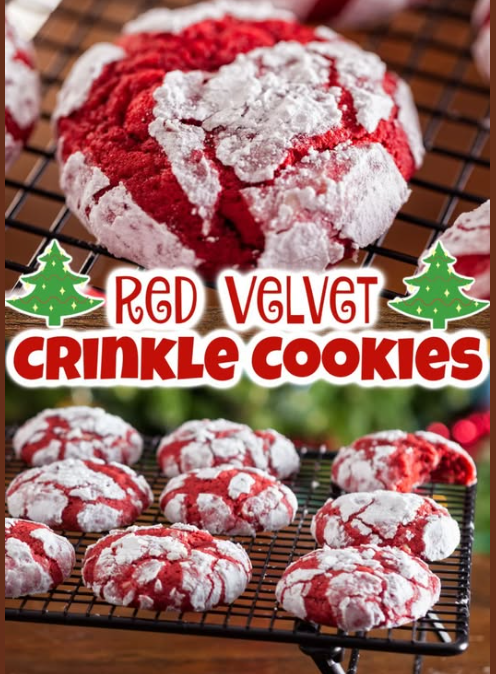
- **The Double-Coat (Crinkle Activation):** Roll each dough ball thoroughly in the $\mathbf{1 \text{ cup of powdered sugar}}$. It is essential to ensure a **thick, non-porous layer** of sugar completely covers the dough ball. **Pro Tip: Roll the ball a second time** after a brief rest or in a second, fresh bowl of powdered sugar to guarantee a heavy coat.
- **Bake:** Place the coated dough balls $\mathbf{2 \text{ inches apart}}$ on the prepared baking sheets. Bake for $\mathbf{9 \text{ to } 11 \text{ minutes}}$. The cookies are done when the tops have cracked beautifully, and the edges are set, but the centers still look slightly soft.
- **Cool:** Cool the cookies on the baking sheet for $\mathbf{5 \text{ minutes}}$ before transferring them to a wire rack to cool completely. This resting period allows the interior structure to fully set.
Serving and Storage: Maintaining the Visual Contrast
The Optimal Serve
The beauty of the crinkle is its striking contrast. Presentation should respect the white-on-red visual impact.
- **Freshness:** These cookies are best enjoyed within **48 hours** of baking, as the moisture from the cookie can gradually be absorbed by the powdered sugar coating, causing it to dull and lose its brilliant white contrast.
- **Pairing:** Serve with a tall glass of cold **milk** (complementing the cake’s classic pairing) or with a cup of robust black **coffee** to cut through the cookie’s sweetness.
- **Garnish:** While usually unnecessary, a light final dusting of fresh powdered sugar just before serving can revive the white color if the coating has faded slightly.
Storage and Longevity
Proper storage is crucial for maintaining both the flavor and the unique crinkle aesthetic.
- **Room Temperature:** Store in an **airtight container** at room temperature for up to **1 week**. Place parchment paper between layers of cookies to prevent the sticky dough from pulling off the powdered sugar coating.
- **Avoid Refrigeration:** Refrigeration is generally discouraged as it can draw moisture to the surface of the cookie, causing the powdered sugar to dissolve or “weep,” ruining the crinkle effect.
- **Freezing Dough (Recommended):** The raw dough freezes beautifully. Scoop and roll the dough balls (Step 5), but **do not coat them in powdered sugar**. Place the dough balls on a baking sheet and freeze until solid. Transfer to a freezer bag for up to $\mathbf{3 \text{ months}}$. When ready to bake, thaw slightly at room temperature, then perform the double-coat (Step 6), and bake as directed.
Tips: Troubleshooting the Perfect Crinkle
Tip: The Powdered Sugar Quality
Ensure your powdered sugar is **fresh and free of lumps**. If it contains lumps, sift it before rolling the dough. Lumps of sugar will create uneven spots in the coating, leading to an imperfect, blotchy crinkle pattern.
Technique and Ingredient Focus
- **Chill Time is King:** If your cookies spread too flat and the crinkle is too subtle, the dough was not chilled long enough. The cold butter in the dough is necessary to slow the spread and force the rapid surface expansion needed for cracking.
- **The Role of Eggs:** The $\mathbf{3 \text{ large eggs}}$ provide significant structure and moisture. Using large eggs is critical; smaller eggs will result in a drier, more crumbly dough that may not crack correctly.
- **Coloring Quality:** Use **gel food coloring** instead of liquid food coloring, if possible. Gel colors are highly concentrated, allowing you to achieve the deep red hue without adding excessive liquid that would alter the flour/moisture balance of the dough.
- **Oven Temperature Accuracy:** A slightly higher oven temperature (like $350^{\circ}\text{F}$) is necessary for crinkle cookies. This high heat causes the rapid expansion required to break the sugar shell. Ensure your oven temperature is accurate using an oven thermometer.
Variations: Flavor Shifts and Textural Changes
The basic crinkle structure can be adapted to carry different flavors, though the chilling and coating steps remain essential.
Color and Flavor Swaps
- **Lemon Crinkle:** Eliminate the cocoa powder and red food coloring. Substitute $\mathbf{1 \text{ teaspoon of vanilla}}$ with $\mathbf{2 \text{ teaspoons of lemon extract}}$ and add $\mathbf{1 \text{ tablespoon of lemon zest}}$. Use yellow food coloring (optional).
- **Peppermint Crinkle:** Add $\mathbf{\frac{1}{2} \text{ teaspoon of peppermint extract}}$ to the wet ingredients and swirl in $\mathbf{\frac{1}{4} \text{ cup of crushed candy canes}}$ during the final mixing phase. Use green or pink food coloring.
- **Chocolate Espresso:** Increase the cocoa powder to $\mathbf{\frac{1}{2} \text{ cup}}$ (reducing flour by $\frac{1}{4}$ cup) and add $\mathbf{1 \text{ tablespoon of espresso powder}}$ to the dry ingredients for a deep, complex flavor. The color will be dark brown, and the contrast will be white on dark brown.
Texture and Inclusion Adjustments
- **Chewy Center Boost:** For an even chewier texture, substitute **$\frac{1}{3} \text{ cup of the granulated sugar}$** with **$\frac{1}{3} \text{ cup of packed brown sugar}$**. The molasses in the brown sugar is highly hygroscopic and will keep the cookie softer and moister longer.
- **Cream Cheese Swirl:** Reduce the butter by $\mathbf{\frac{1}{4} \text{ cup}}$ and beat in $\mathbf{2 \text{ ounces of softened cream cheese}}$ with the butter and sugar. This adds a subtle tang and makes the cookie center even softer.
Tips: High-Level Dough Management
Tip: The Role of Flour Measurement
Ensure the $\mathbf{3 \text{ cups of all-purpose flour}}$ are measured accurately using the **spoon-and-level method** (spooning the flour into the measuring cup and leveling off with a straight edge). Scooping directly from the bag packs the flour too tightly, adding too much dry material, which results in a dense, crumbly dough that won’t spread or crack properly.
Advanced Troubleshooting
- **Coating Disappeared/Dissolved:** This failure occurs if the **dough was not chilled** or the $\mathbf{350^{\circ}\text{F}}$ oven temperature was not reached. The powdered sugar must encounter high heat and a cold, firm dough. If the coating dissolves, the moisture from the dough melted the sugar before the cookie could set.
- **Cookies Didn’t Crack:** This is often a result of **insufficient leavening** or an **improper coating**. Ensure the baking powder and soda are fresh (check expiration dates) and that the dough balls received a truly heavy, **double-layer** coating of powdered sugar. The sugar shell must be thick enough to resist the initial expansion.
- **Cookies are Too Flat:** Aside from not chilling, this can be caused by **over-creaming** the butter and sugar (incorporating too much air, which leads to rapid collapse) or having a kitchen environment that is too warm, causing the dough to melt prematurely on the baking sheet.
- **Color is Dull Brown:** If the final color is not vibrant, it’s usually because the **type of cocoa powder** used (Dutched-process) is too alkaline, neutralizing the red pigment, or simply that the $\mathbf{5 \text{ tsp of food coloring}}$ was insufficient for the volume of dough. Use natural cocoa and check the food coloring measurement.
Conclusion: A Decadent Lesson in Chemistry
The **Red Velvet Crinkle Cookie** is a sophisticated confection whose success hinges on technical precision in the dough preparation and a strategic use of thermal shock. By leveraging the cold fat from the chilling step, the expansive power of the leavening agents, and the insulating barrier of the powdered sugar, the signature crinkle effect is reliably achieved. The cookie provides a decadent textural experience—crisp exterior, chewy interior—with a flavor profile that is subtly chocolatey, deeply vanilla, and profoundly comforting. It is a stunning visual centerpiece and a testament to the elegant science of color and contrast in baking.
Frequently Asked Questions:
Q: Can I use oil instead of butter?
A: **No**. The solid fat structure of the $\frac{3}{4} \text{ cup of softened butter}$ is essential for the creaming process (incorporating air) and for the chilling process (slowing the spread). Substituting with liquid oil will result in a flat, dense cookie that will not crinkle correctly.
Q: What is the best type of food coloring to use?
A: **Gel food coloring** is superior. Because it is highly concentrated, you achieve a much deeper, richer red color saturation using less volume than liquid coloring. Liquid coloring adds too much water to the dough, throwing off the moisture balance and potentially making the dough too sticky.
Q: My powdered sugar coating disappeared during baking. Why?
A: This is the primary failure point. It means the sugar dissolved before the cookie set. The most common causes are **insufficient chilling** (the dough was too warm) or **too light of a sugar coating**. Ensure you chill the dough for the full $\mathbf{2 \text{ hours}}$ and use the **double-coat technique** (re-roll in fresh sugar) to build up a thick, protective layer.
Q: How can I tell when the cookies are done baking?
A: The key indicators are **visual**. The cookies are done when the edges look **set and slightly firm**, the centers still appear **slightly soft and puffy**, and the **cracks are fully formed and visible**. Overbaking will dry out the cookie and lead to a tough texture.