
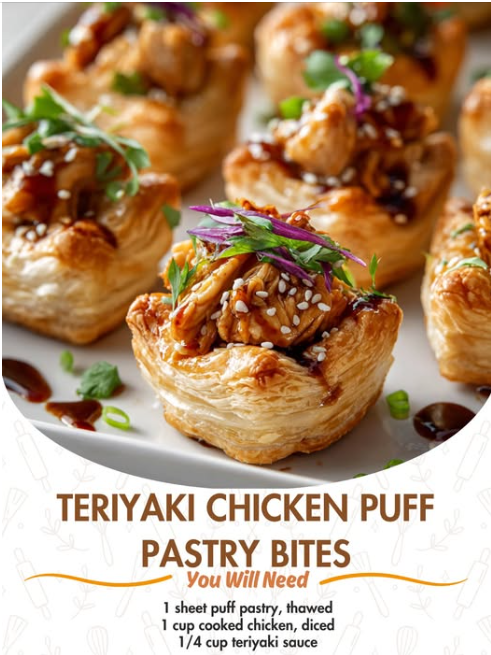
The Biomechanics of Teriyaki Puff Pastry: A Study in Steam Leavening
Introduction: Engineering the Perfect Puff
The success of the Teriyaki Chicken Puff Bite relies on Physical Leavening. Puff pastry is a “laminated” dough, consisting of hundreds of alternating layers of flour and solid fat (usually butter). When placed in a high-temperature environment, the water in the dough and fat turns to steam, forcing the layers apart. This results in a Volumetric Expansion of up to eight times its original height.
The challenge with this specific appetizer is the Teriyaki Glaze. Teriyaki is a high-sugar, high-sodium liquid that can act as a solvent on the dough if not handled correctly. We must manage the viscosity of the sauce to ensure it stays atop the chicken scaffold rather than soaking into the pastry layers before they have a chance to set.
Ingredients: The Molecular Building Blocks
1. The Laminar Scaffold
- 1 Sheet Puff Pastry (Thawed): The Multi-Layered Matrix. It must remain chilled ($<40^\circ\text{F}$) until the moment of assembly to keep the fat layers distinct.
2. The Savory Inclusion
- 1 cup Diced Cooked Chicken: Provides the Protein Bulk. Dicing into small cubes ($\approx 0.5\text{cm}$) increases surface area for sauce adhesion.
- 1/4 cup Teriyaki Sauce: The Flavor Emulsion. High in soy proteins and sugars (mirin/honey), which will undergo intense caramelization.
3. Structural Enhancers (Recommended)
- 1 Egg (Beaten): A Surface Sealant and protein-glaze to enhance browning.
- Sesame Seeds/Green Onions: For Localized Textural Contrast and aromatic finish.
