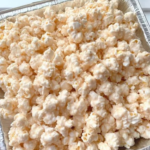
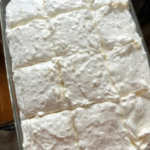
The short ingredient list demands strict adherence to temperature and precise measurement to maintain the delicate structural balance.
| Component | Quantity | Functional Role and Technical Insight |
|---|---|---|
| **The Structural Base (Fat and Flour)** | ||
| **Unsalted Butter, cold** | 1 cup | **Tenderizer:** Must be cold. Inhibits gluten formation for a crumbly texture and carries the dominant flavor. |
| **All-Purpose Flour** | $1 \frac{3}{4}$ cups | **Structure/Bulk:** The bulk of the dry ingredients. Accurate, light measurement prevents a dense, hard cookie. |
| **The Flavor and Consistency** | ||
| **Powdered Sugar** | $\frac{3}{4}$ cup | **Sweetness/Anti-Gluten:** Fine particles and cornstarch content promote a smooth mouthfeel and aid tenderness. |
| **Vanilla Extract** | 1 teaspoon | **Aroma Enhancer:** Amplifies the perception of butter richness without altering the core structure. |
Instructions: Minimizing Work for Maximum Tenderness
The instruction set is focused on controlling temperature and minimizing mixing to prevent gluten development.
- **Oven Prep and Pan Lining:** Preheat the oven to $\mathbf{325^{\circ}\text{F}}$ ($\mathbf{160^{\circ}\text{C}}$). Line a $\mathbf{9 \times 13 \text{-inch baking pan}}$ with **parchment paper**, ensuring the paper overhangs the long sides (this creates a “sling” for easy removal).
- **Creaming (Cold):** In the bowl of an electric mixer, combine the $\mathbf{1 \text{ cup of cold, cubed butter}}$, $\mathbf{\frac{3}{4} \text{ cup of powdered sugar}}$, and $\mathbf{1 \text{ tsp of vanilla extract}}$. Beat on medium-low speed until the mixture is creamy and well-combined, but **do not over-aerate**. The mixture should still be cool to the touch. Scrape the bowl often.
- **Flour Incorporation (Slow and Low):** Turn off the mixer. Slowly incorporate the $\mathbf{1 \frac{3}{4} \text{ cups of flour}}$ little by little, mixing on the absolute lowest speed. Stop the mixer when large crumbs form.
- **Dough Formation (Minimal Handling):** Add the $\mathbf{3 \text{ to } 4 \text{ tablespoons of sprinkles}}$ (if using) and mix briefly just to distribute. Use your **hands** to quickly work the mixture into a cohesive ball. **Do not overwork** the dough; use just enough pressure to make it stick together.
- **Press and Chill (Setting the Shape):** Press the dough evenly into the prepared $\mathbf{9 \times 13 \text{ inch pan}}$. Use the flat bottom of a measuring cup or glass to ensure a uniform thickness. Chill for a **mandatory 1 hour** in the fridge. This hardens the butter, preventing spread during baking and making the dough easy to cut.
- **Cut and Arrange:** Using the parchment paper overhang, remove the chilled dough from the pan. Cut the dough into neat, **bite-size squares** (e.g., $1 \text{-inch}$ squares). Place the squares $\mathbf{1 \text{ inch apart}}$ on an ungreased cookie sheet.
- **Bake (Low and Slow):** Bake for $\mathbf{10 \text{ to } 12 \text{ minutes}}$, or until the edges and bottoms just begin to show a faint hint of golden brown. Shortbread should remain pale.
- **Cool:** Cool completely on the pan. The cookies will crisp up as they cool.
Serving and Storage: Maintaining Crispness and Flavor
Optimal Serving Temperature and Presentation
Shortbread is best served at **room temperature**. Serving it cold dulls the intensity of the butter flavor.
- **Post-Bake Finishing:** For an extra festive touch, dust the warm cookies lightly with powdered sugar immediately after removing them from the oven. This creates a fine, snowy layer that adheres as the cookies cool.
- **Flavor Amplification:** The buttery profile pairs exceptionally well with strong, acidic beverages. Serve with rich, dark coffee or spiced black tea.
Storage and Longevity
Shortbread’s low moisture content ensures excellent shelf stability, but proper storage is key to maintaining crispness.
- **Room Temperature:** Store cooled shortbread in an **airtight container** at room temperature for up to **10 days**. The low moisture content makes it highly shelf-stable.
- **Freezing Baked Cookies:** Baked shortbread freezes exceptionally well. Layer the cooled squares in a freezer-safe container, separated by parchment paper, for up to $\mathbf{6 \text{ months}}$. Thaw at room temperature.
- **Freezing Dough (Make-Ahead):** The pressed dough (Step 5), wrapped tightly in plastic wrap, can be frozen for up to $\mathbf{2 \text{ months}}$. Thaw overnight in the refrigerator before cutting and baking.
- **Preventing Softening:** Always ensure the shortbread is completely cool before placing it in an airtight container. Trapped heat creates moisture (condensation), which will soften the texture and encourage staling.
Tips: Mastering the Minimalist Technique
Tip: Accuracy in Flour Measurement
The ratio of flour to fat is everything in shortbread. Always use the **spoon-and-level method** for the $\mathbf{1 \frac{3}{4} \text{ cups of all-purpose flour}}$. Scooping flour directly from the bag compacts it, resulting in $\mathbf{10\% \text{ to } 20\%}$ too much flour by weight. This excess will create a dense, dry, and tough shortbread instead of the signature crumbly texture.
Technical Pointers
- **Do Not Overmix:** The dough should be mixed only until it just comes together. Excessive mixing develops the gluten network, leading to a hard, chewy cookie instead of a crumbly shortbread. Use the lowest mixer speed and switch to **hand kneading** (Step 4) only until a cohesive ball is formed.
- **Cold Butter is Non-Negotiable:** Using cold butter ensures the shortening effect is maximized. If your kitchen is warm, chill the bowl and the mixer paddle beforehand to maintain the butter’s temperature.
- **Uniform Thickness:** Pressing the dough into a $\mathbf{9 \times 13 \text{-inch pan}}$ and then chilling ensures the entire batch has a perfectly uniform thickness. This guarantees **even baking**—a crucial factor since shortbread is baked low and slow.
- **Don’t Overbake:** Shortbread is defined by its pale color. Overbaking leads to a hard, dry cookie and compromises the buttery flavor. The key indicators for doneness are **lightly set edges** and the **faintest hint of browning on the bottom**.
Variations: Adjusting Flavor and Density
While the classic formula is simple, its neutrality allows for easy flavor customization without altering the core structure.
Flavor and Aroma Swaps
- **Spiced Orange:** Add $\mathbf{1 \text{ teaspoon of finely grated orange zest}}$ (rubbed into the sugar) and $\mathbf{\frac{1}{2} \text{ teaspoon of ground cardamom}}$ to the dry ingredients. Omit the vanilla extract.
- **Toasted Almond:** Substitute $\mathbf{\frac{1}{4} \text{ cup of the all-purpose flour}}$ with $\mathbf{\frac{1}{4} \text{ cup of finely ground almond flour}}$ for a subtle nutty flavor. Add $\mathbf{\frac{1}{2} \text{ teaspoon of almond extract}}$ instead of vanilla.
- **Cocoa Nib Crunch:** Mix in $\mathbf{2 \text{ tablespoons of finely chopped cocoa nibs}}$ and $\mathbf{\frac{1}{4} \text{ teaspoon of fine sea salt}}$ (added to the dough) for a bittersweet crunch and savory depth.
Texture and Shape Alterations
- **Scottish-Style Snap:** Replace the $\mathbf{\frac{3}{4} \text{ cup of powdered sugar}}$ with $\mathbf{\frac{1}{2} \text{ cup of granulated sugar}}$ and $\mathbf{\frac{1}{4} \text{ cup of rice flour}}$. Rice flour contains no gluten, enhancing the crumbly texture and providing the signature “sandy” snap of traditional Scottish shortbread.
- **Glazed Finish:** Skip the sprinkles. Once cooled, drizzle the squares with a simple thin glaze made from powdered sugar and milk/lemon juice.
- **Traditional Rounds:** Instead of pressing into a pan, shape the dough into a $\mathbf{1 \text{-inch thick log}}$. Chill, slice into $\mathbf{\frac{1}{4} \text{-inch thick rounds}}$, prick with a fork, and bake as directed.
Tips: Advanced Structural Control
Tip: The Rice Flour Advantage
For the ultimate melt-in-your-mouth shortbread texture, substitute $\mathbf{\frac{1}{4} \text{ cup of the all-purpose flour}}$ with $\mathbf{\frac{1}{4} \text{ cup of finely sifted rice flour}}$. Rice flour prevents any potential chewiness and guarantees a superior, sandy crumb due to its lack of gluten.
Troubleshooting and Refining the Bake
- **Cookie is Chewy/Hard:** This is a failure of **gluten control**. The dough was either overmixed (developing the gluten) or too much flour was used (mis-measurement). Reduce mixing time and ensure the flour is measured lightly.
- **Cookie is Greasy/Spreading:** This is a failure of **temperature control**. The butter was likely too warm when the flour was added, causing it to melt and inhibit proper coating of the flour particles. Always use cold butter and chill the dough for the full hour.
- **Salting for Balance:** If using unsalted butter, adding a **pinch of salt** (around $\mathbf{\frac{1}{4} \text{ teaspoon}}$) to the flour is highly recommended. Salt enhances the perception of the butter flavor and balances the sweetness of the sugar.
- **Baking Temperature Check:** Ensure your oven is accurate. Shortbread baked too high will brown too quickly on the edges and remain raw in the center. Use an oven thermometer if you suspect your oven runs hot. The $\mathbf{325^{\circ}\text{F}}$ temperature is intentionally low.
Conclusion: A Decadent Lesson in Fat-Flour Dynamics
The **4-Ingredient Christmas Shortbread Cookie Bite** is a testament to the power of simplicity in baking. Its success is entirely reliant on the strategic use of high-fat, cold ingredients and a commitment to **minimal dough manipulation**. By maximizing the **shortening effect** of the cold butter and carefully controlling the flour-to-fat ratio, the baker achieves the characteristic crumbly texture and intense buttery flavor. The result is a perfect, pale, and structurally sound holiday biscuit that delivers maximum flavor and tenderness with minimum effort.
Frequently Asked Questions:
Q: Can I use salted butter?
A: **Yes**, you can use salted butter, but it is not ideal. Salted butter has a higher water content and the salt level varies by brand. If you use it, be aware your cookie may spread slightly more, and the final flavor may be saltier. If you use salted butter, **do not add any extra salt** to the flour.
Q: Why is chilling the dough for an hour necessary?
A: Chilling the dough serves two functions: 1) It **hardens the butter** which was slightly softened during mixing, preventing the cookie from spreading excessively in the oven. 2) It makes the dough firm enough to be **removed and cut cleanly** into perfect squares (Step 9) without deforming.
Q: My shortbread is tough and chewy. What went wrong?
A: The dough was **overmixed**. Overmixing develops the gluten network in the flour, which leads to chewiness rather than the desired crumbly, tender texture. Once the flour is added, mix only until the dough just comes together and then stop.
Q: Should I grease the cookie sheet?
A: **No.** Shortbread is extremely high in fat (butter), which prevents sticking. Greasing the sheet or lining it with heavily oiled parchment paper could cause the butter in the dough to melt and spread too quickly.