
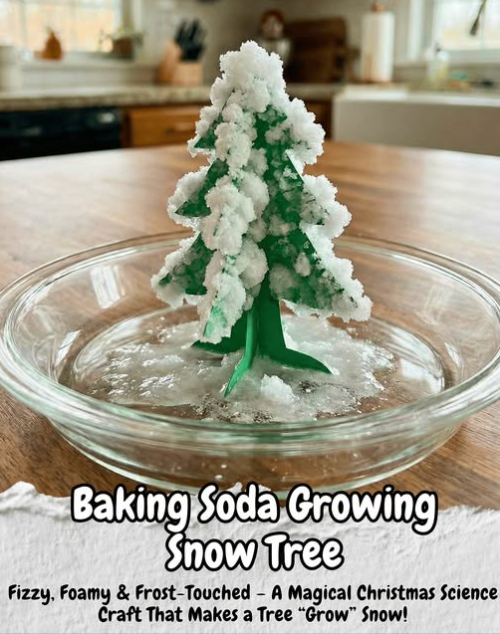
The Growing Snow Tree: A Lesson in Chemical Kinetics
An immersive sensory experiment that combines festive art with the foundational principles of acid-base chemistry.
The Science Behind the “Snow”
This experiment centers on the reaction between an acid (Vinegar) and a base (Baking Soda). When they combine, they undergo a two-step reaction. First, they form carbonic acid, which is unstable and immediately decomposes into water and Carbon Dioxide ($CO_2$) gas.
Technically, the **Dish Soap** is a Surfactant. It reduces the surface tension of the liquid, allowing the $CO_2$ gas to be encapsulated in millions of tiny bubbles. This creates a “Colloidal Foam” that is far denser and slower-moving than a standard vinegar-soda volcano, allowing the “snow” to cling to the tree shape as it “grows.”
Success with this experiment relies on two critical factors: The Packability Ratio (getting the moisture right so the tree stands tall) and The Surfactant Concentration (enough soap to ensure the foam is thick and snowy).
Required Materials: The Chemical Infrastructure
- 2 Cups Baking Soda (Sodium Bicarbonate): The base and structural bulk of the tree.
- ½ Cup Water: Used as the binding agent for the “snow” mold.
- 2–3 tbsp Dish Soap: The foaming agent that stabilizes the $CO_2$.
- Green Food Coloring: To provide the evergreen aesthetic.
- Glitter (Silver/Iridescent): To mimic the crystalline reflection of real frost.
- Vinegar (Acetic Acid): The liquid catalyst that triggers the eruption.
