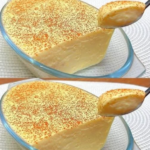

Why does this pie become firm without being baked into a traditional custard? The answer lies in **Acid-Induced Coagulation**.
Sweetened condensed milk is high in casein proteins. When you add the citric acid from the lemon juice ($C_6H_8O_7$), it lowers the pH of the mixture. This causes the proteins to denature and “tangle” together, creating a thick, stable matrix. This is effectively the same process used to make ricotta cheese or yogurt.
The chemical reaction can be summarized as:
$$ \text{Casein (sol)} + \text{H}^{+} \text{(from Lemon Juice)} \rightarrow \text{Casein (gel)} $$
While the acid does the initial thickening, we add egg yolks and a short bake in this version to ensure the pie is food-safe and has a professional “slice-ability” that stands up to 2026 standards.
4. Step-by-Step Methodology
Prepare the Crust
Mix the graham cracker crumbs, sugar, and salt in a bowl. Pour in the melted butter and stir until it looks like wet sand. Press the mixture firmly into the bottom and up the sides of a 9-inch deep-dish pie plate. Bake at **350°F (175°C)** for 8–10 minutes until golden and fragrant. Allow it to cool completely before adding the filling.
The Filling Emulsion
In a large bowl, whisk the 4 egg yolks and lemon zest for about 2 minutes until they turn a pale yellow. Whisk in both cans of sweetened condensed milk. Finally, slowly pour in the lemon juice while whisking constantly. You will feel the mixture thicken almost immediately as the acid reacts with the milk proteins.
The Short Bake
Pour the filling into the cooled crust. Bake at **350°F (175°C)** for 15 minutes. This doesn’t “cook” the pie in a traditional sense, but it sets the egg yolks and ensures the pie won’t “slump” when cut. The center should have a slight jiggle but feel firm to the touch.
The Icebox Phase
This is the most critical step. Let the pie cool to room temperature, then transfer it to the refrigerator. It must chill for at least 6 hours, preferably overnight. This cold-setting allows the molecular bonds to fully stabilize.
5. The Final Flourish: Toppings
A Lemon Icebox Pie is not complete without a contrast to its sharp acidity. In 2026, we recommend two paths:
| Option | Ingredients | Vibe |
|---|---|---|
| Stabilized Whipped Cream | Heavy cream, powdered sugar, vanilla bean paste. | Classic, airy, and elegant. |
| Toasted Meringue | The 4 leftover egg whites, sugar, cream of tartar. | Dramatic, sweet, and torch-finished. |
6. Expert Troubleshooting
Why is my pie too tart?
Lemon acidity varies by season and variety. Eureka lemons are standard, but if you want a sweeter, floral profile, swap 50% of the juice for Meyer Lemon juice.
Can I make this vegan?
By 2026, high-quality condensed coconut milk has become widely available. You can swap the milk for a coconut-based alternative and the egg yolks for a cornstarch slurry, though the texture will be slightly more “pudding-like.”
7. Storage and Longevity
Because of its high sugar and acid content, the Lemon Icebox Pie keeps remarkably well. It can be stored in the refrigerator for up to 5 days. Interestingly, it is also a fantastic freezer pie. If you freeze it, let it sit on the counter for 15 minutes before serving; it will have the texture of a premium lemon gelato.
8. Conclusion
The Lemon Icebox Pie is a testament to the fact that great cooking doesn’t always require heat or complexity. It is about understanding how ingredients talk to one another. Whether you are serving this at a 2026 backyard barbecue or as a refined Sunday dinner finale, its bright, unapologetic flavor is guaranteed to be the highlight of the meal. Happy baking!