ADVERTISEMENT
We complete the ingredients, separating them by the core components needed for either a batter or a dry breading.
I. The Core Pickle Component:
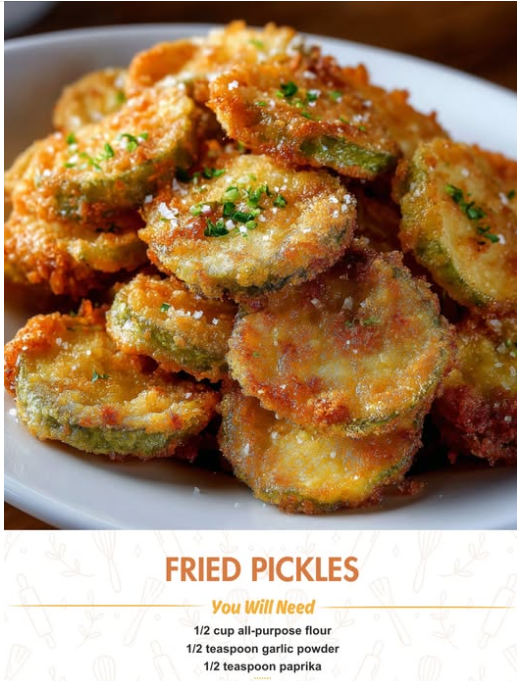
- 1 jar (16 oz) dill pickle chips or spears: Ensure they are firm. Chips are easier to eat, while spears offer more internal texture.
II. The Shared Seasoning Base:
- ½ cup all-purpose flour: Used as the coating base (for batter) or the first dredge (for breading).
- ½ teaspoon garlic powder: Essential savory seasoning.
- ½ teaspoon paprika (or smoked paprika): Adds color and aromatic depth.
- ½ teaspoon salt and ½ teaspoon black pepper: The primary seasoning agents for the crust.
III. Method A: For the Light, Airy **BATTER**
- ¾ cup cold beer or club soda: The secret to an airy, crispy batter. The carbonation and cold temperature create steam during frying, resulting in a lighter, less dense coating.
- 1 teaspoon baking powder: Provides chemical leavening, further guaranteeing a puffy texture.
IV. Method B: For the Heavy, Crunchy **BREADING**
- 1 large egg, beaten: The essential glue (the “wet” stage).
- 1 cup Panko breadcrumbs (or standard breadcrumbs): Provides the texture (the “final dry” stage). Panko is highly recommended for its superior crispness.
- Extra ½ cup all-purpose flour: Used for the initial dry dredge.
V. The Frying Medium:
- 3 cups vegetable oil, canola oil, or peanut oil: A neutral oil with a high smoke point for deep frying.
Crucial Pre-Prep: Regardless of the method chosen, the pickles must be **thoroughly drained and patted bone-dry** before coating. This step alone accounts for 50% of the recipe’s success.
Method A: The Light, Puffy Batter Fry
This method yields a texture similar to tempura—light, airy, and very crisp. The key is using cold, carbonated liquid.
Directions for Batter Fry:
- Moisture Control: Drain the pickles and lay them on paper towels. **Press firmly** to remove all surface moisture.
- Mix Dry Ingredients: In a medium bowl, whisk together the **½ cup flour, garlic powder, paprika, baking powder, salt, and pepper**.
- Add Liquid: Slowly whisk in the **cold beer or club soda** until just combined. The batter should be the consistency of a thin pancake batter—lumpy is okay, but do not overmix, as this develops gluten and makes the batter tough.
- Heat the Oil: Heat the frying oil in a deep pot to a precise temperature of **$365^\circ\text{F}$ ($185^\circ\text{C}$)**.
- Dip and Fry: Dip a handful of dry pickle slices into the batter, letting the excess drip off. Immediately place the coated pickles into the hot oil. Fry in small batches for **2–3 minutes**, flipping once, until deep golden brown and puffy.
- Drain and Serve: Remove with a slotted spoon and place on a wire rack (not paper towels) to drain. Sprinkle with extra salt immediately. Serve hot.
Method B: The Crunchy, Three-Stage Breading
This is the classic technique for heavy crunch, often seen in restaurants. It uses the **Standard Breading Procedure (SBP)**: Dry $\to$ Wet $\to$ Dry.
Directions for Breading Fry:
- Moisture Control: Drain the pickles and lay them on paper towels. **Press firmly** to remove all surface moisture.
- Setup the Assembly Line: Set up three shallow dishes:
- Dish 1 (Dry): **Extra ½ cup flour** seasoned with a pinch of salt/pepper.
- Dish 2 (Wet): **1 beaten egg**.
- Dish 3 (Final Dry): **1 cup Panko breadcrumbs** seasoned with the remaining garlic powder and paprika.
- The Coat: Take one pickle at a time and pass it through the stages: **Flour $\to$ Egg $\to$ Panko**. Press the Panko firmly onto the pickle to ensure full coverage.
- The Chill: Place the coated pickles on a parchment-lined tray and **refrigerate for 15 minutes**. This critical step sets the breading and prevents it from falling off during frying.
- Heat and Fry: Heat the frying oil in a deep pot to a precise temperature of **$350^\circ\text{F}$ ($175^\circ\text{C}$)**. Fry the chilled pickles in small batches for **2–3 minutes** until they are deep golden brown.
- Drain and Serve: Remove with a slotted spoon and place on a wire rack to drain. Serve immediately.
Frying Theory and Troubleshooting: Achieving the Non-Greasy Finish
The key to a non-greasy fried item is **temperature management**. Oil must be hot enough to form a hard crust instantly, preventing oil absorption.
Temperature is King:
- Too Cold (Below $325^\circ\text{F}$): The oil seeps into the batter/breading before the crust hardens, resulting in a **soggy, oily** final product.
- Ideal Range ($350^\circ\text{F}$ to $365^\circ\text{F}$): The sweet spot. The crust sets instantly, and the internal moisture turns to steam, which puffs the coating and cooks the pickle core.
- Too Hot (Above $375^\circ\text{F}$): The coating burns before the inner layer of the crust fully dehydrates, resulting in a dark exterior and a soft, underdeveloped crust interior.
Common Troubleshooting:
- **Coating Falling Off:** Almost always due to insufficient **patting dry** or skipping the **chilling step** (Method B).
- **Oil Spitting/Sputtering:** The pickles are still too wet. Remove them and pat them dry again before re-coating or re-dipping.
- **Soggy After Draining:** The oil temperature was likely too low, causing the coating to soak up the oil rather than repel it.
Tips and Variations: Beyond the Basics
Pro-Tips for Pickle Perfection:
- **Use a Thermometer:** A simple clip-on candy or deep-fry thermometer is inexpensive and essential for maintaining the correct temperature.
- **Fry in Batches:** Crowding the pot lowers the oil temperature dramatically, leading to soggy results. Fry in small batches and allow the oil to return to temperature between batches.
- **Double-Dredge (Method B):** For an extra-thick crust, pass the pickle back through the egg and Panko stations a second time.
Dipping Sauce Pairings:
A creamy, tangy sauce is necessary to contrast the brine and the heat of the fryer:
- Spicy Ranch: Mix ranch dressing with a squirt of Sriracha or a pinch of cayenne pepper.
- Cajun Aioli: Mayonnaise mixed with garlic, lemon juice, and Cajun seasoning.
- Honey Mustard: A sweet and tangy classic that pairs well with the acidic pickle.
Conclusion: Achieving the Ultimate Crunch
Whether you choose the light puffiness of the **carbonated batter** or the hearty crunch of the **three-stage breading**, the key to legendary fried pickles is non-negotiable adherence to technique. Mastering moisture control and oil temperature management ensures that the tangy, warm pickle filling is perfectly encased in a golden, crispy, and non-greasy shell. Serve them hot and watch them disappear!
ADVERTISEMENT