Each of the three ingredients plays a distinct role in structural formation and texture.
| Component | Quantity | Functional Role and Technical Insight |
|---|---|---|
| **The Base (Moisture and Flavor)** | ||
| **Canned Sliced Peaches (undrained)** | 2 cans (15 oz each) | **Liquid/Sugar Source:** Provides moisture for hydration and sugar for caramelization; the syrup thickens during baking. |
| **The Topping (Structure and Leavening)** | ||
| **Dry Cake Mix** | 1 box (15.25 oz) | **Dry Structure:** Contains all dry agents (flour, leaveners, sugar); forms the light, porous structure upon baking. |
| **Unsalted Butter, melted** | $\frac{3}{4}$ cup | **Crispness/Shortening:** High-fat content inhibits gluten, ensuring tenderness; promotes surface browning and crispness. |
Instructions: Layering for Hydration and Crispness
The instructions focus on the layering technique, which is essential for the cobbler’s texture.
- **Preheat & Prep:** Preheat your oven to $\mathbf{350^{\circ}\text{F}}$ ($\mathbf{175^{\circ}\text{C}}$). Lightly grease a $\mathbf{9 \times 13 \text{-inch baking dish}}$. The grease aids in heat transfer and prevents the caramelized fruit base from sticking.
- **Establish the Fruit Base:** Pour the $\mathbf{2 \text{ cans of undrained sliced peaches}}$ into the prepared baking dish, distributing the fruit evenly. **Do not stir** the fruit and juice after pouring.
- **Sprinkle Dry Mix:** Evenly **sprinkle** the entire $\mathbf{15.25 \text{ oz box of dry cake mix}}$ over the top of the fruit base. Try to achieve an even layer; avoid dumping it in clumps. **Do not stir** the cake mix into the fruit.
- **Add the Fat:** Drizzle the $\mathbf{\frac{3}{4} \text{ cup of melted butter}}$ evenly over the surface of the dry cake mix. Ensure the butter covers as much surface area as possible.
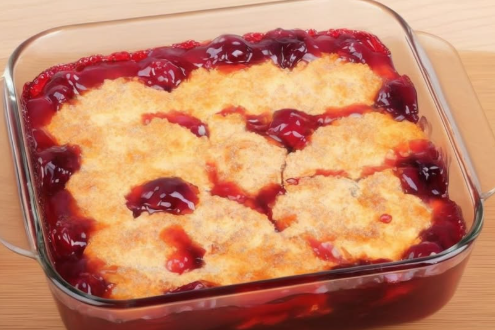
- **Bake:** Bake for $\mathbf{45 \text{ to } 55 \text{ minutes}}$, or until the topping is $\mathbf{\text{deep golden brown}}$ and the fruit filling is visibly $\mathbf{\text{bubbling vigorously}}$ around the edges.
- **Cool and Serve:** Allow the cobbler to cool slightly ($\mathbf{15 \text{ minutes}}$) before serving. This allows the fruit syrup to thicken and the topping to fully set.
Serving and Storage: Post-Bake Thickening
Optimal Serving and Texture
Cobblers are best served warm, allowing the texture of the crisp topping and the syrupy fruit to shine.
- **Serving Time:** Serve the cobbler $\mathbf{\text{warm}}$, preferably topped with a scoop of vanilla ice cream or a dollop of whipped cream, which melts into the warm fruit syrup.
- **Thickening:** The $\mathbf{15 \text{-minute cooling time}}$ (Step 6) is crucial. As the cobbler cools, the starches and sugars in the peach juice and cake mix base will continue to hydrate and thicken, preventing a runny consistency.
Storage and Longevity
Due to the high fruit and sugar content, this cobbler stores reasonably well at room temperature initially, but refrigeration is recommended for long-term freshness.
- **Room Temperature:** The cobbler can be loosely covered and kept at a cool room temperature for up to $\mathbf{24 \text{ hours}}$.
- **Refrigeration:** Cover tightly and refrigerate for up to $\mathbf{4 \text{ days}}$. The topping may soften slightly in the refrigerator due to moisture migration from the fruit base.
- **Reheating:** Reheat individual servings in the microwave or place the entire cobbler back in the oven ($\mathbf{350^{\circ}\text{F}}$) for $\mathbf{15 \text{ minutes}}$ to crisp the topping before serving.
Tips: Maximizing Crispness and Browning
Tip: The Don’t Stir Mandate
It is absolutely critical to **not stir** the dry cake mix layer into the fruit base (Step 3). The success of this recipe relies on the cake mix slowly wicking up the moisture from the fruit syrup from below. Stirring creates a cake batter, resulting in a soggy, uniformly cakey consistency rather than a crisp cobbler topping.
Technical Pointers
- **Pre-Melted Butter:** The use of $\mathbf{\frac{3}{4} \text{ cup of melted butter}}$ (Step 4) ensures the fat penetrates the dry mix evenly. Using cold, cubed butter, as in a crumble, would create a different, more granular texture. The liquid state of the butter encourages uniform browning.
- **Browning Control:** If the topping begins to brown too quickly before the fruit base is bubbling, cover the baking dish loosely with $\mathbf{\text{aluminum foil}}$ for the last $\mathbf{10 \text{ minutes}}$ of baking.
- **Accurate Temperature:** Bake at a consistent $\mathbf{350^{\circ}\text{F}}$. Too low a temperature will prevent the leaveners in the cake mix from fully activating, resulting in a dense, heavy topping.
- **Altitude Adjustment:** At high altitudes, liquid evaporates faster. If you are baking above $\mathbf{3,500 \text{ feet}}$, consider adding $\mathbf{2 \text{ tablespoons of water or milk}}$ to the melted butter before drizzling to ensure enough moisture is present for the cake mix to hydrate.
Variations: Adjusting Acidity and Flavor
Simple additions can drastically alter the final flavor profile and textural balance.
Fruit and Base Swaps
- **Berry Blast:** Substitute the $\mathbf{2 \text{ cans of peaches}}$ with $\mathbf{4 \text{ cups of frozen mixed berries}}$. To compensate for the lower sugar content, sprinkle $\mathbf{\frac{1}{4} \text{ cup of granulated sugar}}$ over the berries before adding the cake mix.
- **Apple Cinnamon:** Use $\mathbf{4 \text{ cups of canned apple pie filling}}$ as the base. Use a $\mathbf{\text{spice cake mix}}$ instead of yellow for a warm, fragrant topping.
- **Citrus Zing:** Add the $\mathbf{\text{zest of one lemon}}$ to the dry cake mix before sprinkling (Step 3) to introduce a bright, fresh aromatic contrast to the sweet peaches.
Topping and Enrichment
- **Nutty Crunch:** Sprinkle $\mathbf{\frac{1}{2} \text{ cup of chopped pecans or walnuts}}$ over the dry cake mix before drizzling with butter (Step 4). The nuts toast in the melted butter, adding an extra layer of crunch and flavor.
- **Brown Sugar Finish:** Before baking, lightly sprinkle the top of the butter layer with $\mathbf{2 \text{ tablespoons of light brown sugar}}$. The molasses in the brown sugar intensifies the browning and adds a deeper caramel flavor.
- **Dairy Swap:** For an even richer, slightly tangier flavor, substitute the $\mathbf{\frac{3}{4} \text{ cup of melted butter}}$ with $\mathbf{\text{browned butter}}$. Melt the butter slowly until the milk solids turn golden brown, then drizzle as directed.
Tips: Advanced Heat and Moisture Management
Tip: Pre-Wicking the Bottom Layer
If you find the very bottom layer of the cake mix is sometimes left dry, place the baking dish on top of the $\mathbf{\text{warm stove or a sunny countertop}}$ for $\mathbf{10 \text{ minutes}}$ after sprinkling the mix (Step 3) and before adding the butter. This gentle heat encourages the peach juice to wick up into the base of the cake mix layer, ensuring uniform hydration.
Baking Science Deep Dive
- **Maillard Reaction:** The golden brown color of the topping is primarily due to the **Maillard reaction** (the interaction between amino acids and reducing sugars) and **caramelization** (the oxidation of sugar). The $\mathbf{\text{melted butter}}$ provides the necessary fat medium to promote these reactions across the surface of the cake mix.
- **The Cobbler Effect:** A true cobbler is characterized by a bumpy, biscuit-like topping. This recipe achieves a $\mathbf{\text{simplified cobbler effect}}$ because the cake mix is not fully mixed with liquid; it partially hydrates, puffs up due to the leaveners, and then is sealed by the fat layer, creating an irregular, crunchy surface rather than a smooth cake layer.
- **Sugar Content:** Canned peaches are packed in a high-sugar syrup. This high sugar concentration not only provides sweetness but controls the $\mathbf{\text{water activity}}$ within the cobbler, ensuring the fruit base retains moisture while the topping can dry out and crisp.
- **Uniform Drizzle:** Drizzling the melted butter $\mathbf{\text{evenly}}$ (Step 4) is critical. Any dry pockets that the butter does not penetrate will remain dry, powdery, and un-crisped after baking.
Conclusion: A Decadent Lesson in Layered Hydration
The **3-Ingredient Cake Mix Cobbler** is a brilliant demonstration of culinary efficiency. Its success lies in the strategic use of $\mathbf{\text{pre-packaged ingredients}}$ to manage moisture and leavening. The $\mathbf{\text{peach syrup}}$ hydrates the $\mathbf{\text{dry cake mix}}$ from below, activating its leaveners, while the $\mathbf{\text{melted butter}}$ creates a protective, flavor-rich, and crisp $\mathbf{\text{fat layer}}$ on top. This layered approach ensures a sweet, bubbling fruit base and a crunchy, golden brown topping, achieving a decadent result with minimal effort and complexity.
Frequently Asked Questions:
Q: Can I use light butter or margarine instead of $\frac{3}{4}$ cup of unsalted butter?
A: **Not recommended.** Light butter and margarine contain $\mathbf{\text{more water}}$ and $\mathbf{\text{less fat}}$ than full-fat butter. This extra water will hydrate the cake mix too much, resulting in a $\mathbf{\text{soggy, dense topping}}$ instead of a crisp one. The $\mathbf{\text{high fat content}}$ of the $\mathbf{\frac{3}{4} \text{ cup of butter}}$ is essential for the shortening and crisping effect.
Q: Do I need to thaw frozen fruit before using it?
A: **No.** If substituting $\mathbf{\text{frozen fruit}}$, pour it directly into the baking dish. It will release more liquid as it bakes, which is fine for the cobbler structure, but you may need to add $\mathbf{5 \text{ to } 10 \text{ minutes}}$ to the total baking time.
Q: Why is my fruit filling runny even after cooling?
A: This is usually due to $\mathbf{\text{not enough sugar}}$ (if using unsweetened fruit) or $\mathbf{\text{not baking long enough}}$. The bubbling around the edges (Step 5) indicates the fruit syrup has reached a high enough temperature for its sugars and starches to $\mathbf{\text{thicken}}$. If the syrup is still runny, bake for $\mathbf{5 \text{ to } 10 \text{ more minutes}}$.
Q: Can I use self-rising flour instead of cake mix?
A: $\mathbf{\text{Yes, with adjustments}}$. Self-rising flour already contains leaveners and salt, but it lacks the necessary $\mathbf{\text{sugar}}$. You would need to mix $\mathbf{1 \frac{1}{2} \text{ cups of self-rising flour}}$ with $\mathbf{1 \text{ cup of granulated sugar}}$ before sprinkling it over the fruit base.