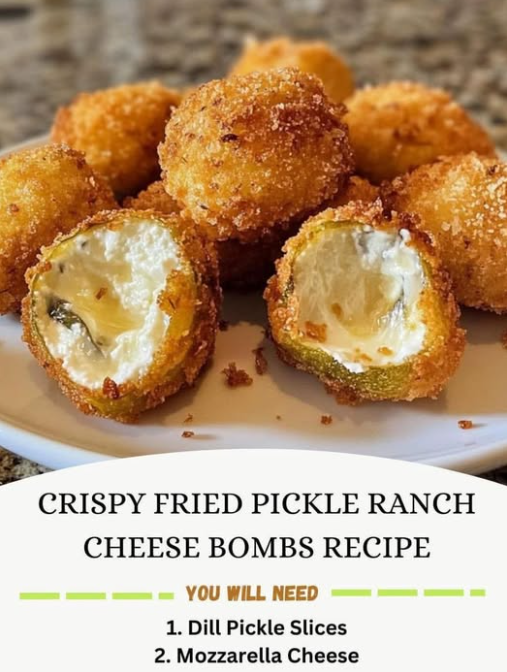
Each ingredient plays a dual role: contributing to the final flavor while also ensuring the structural stability of the cheese core.
| Component | Quantity | Functional Role and Technical Insight |
|---|---|---|
| **The Core (Structure and Moisture Control)** | ||
| **Dill Pickle Slices (Diced)** | $\frac{1}{2}$ cup | **Flavor & Acidity:** Must be diced small and aggressively dried (moisture management is paramount). |
| **Cream Cheese, softened** | 4 ounces | **Binder:** High-fat, low-melt point cheese that holds the core together during handling and initial melt. |
| **Shredded Cheddar Cheese** | 1 cup | **Melt & Goo:** Provides the signature color, savory flavor, and molten texture upon heating. |
| **Ranch Seasoning Mix** | 1 tablespoon | **Flavor Infusion:** Dry herb/spice blend that defines the savory flavor profile. |
| **The Coating (Crunch and Seal)** | ||
| **Panko Breadcrumbs** | $1 \frac{1}{2}$ cups | **Superior Crunch:** The flaky, crustless texture minimizes oil absorption. |
| **All-Purpose Flour** | $\frac{1}{2}$ cup | **Pre-Adhesion:** Creates a dry surface that the egg wash can uniformly adhere to. |
Instructions: Freezing and Frying Protocol
The instructions meticulously guide the preparation, freezing, and frying phases, ensuring optimal results.
- **Pickle Preparation (Crucial Drying):** Mince the $\mathbf{\frac{1}{2} \text{ cup of dill pickle slices}}$ very finely. Place the minced pickles in a sieve and press out any excess liquid. Then, transfer to a paper towel and **aggressively pat completely dry** (the drier, the better).
- **Form the Core:** In a mixing bowl, combine the **4 ounces of softened cream cheese**, **1 cup of shredded Cheddar**, $\mathbf{1 \text{ Tbsp of dry Ranch seasoning}}$, and the **dried minced pickles**. Mix thoroughly until homogenous.
- **Shape and Freeze (Thermal Lock):** Scoop the mixture into $\mathbf{1 \text{-inch balls}}$. Roll them into smooth spheres and place them on a parchment-lined tray. **Freeze for a minimum of 4 hours, or until rock solid.**
- **The Triple-Coating Setup:** Set up a triple breading station with three shallow dishes:
- **Station 1:** $\frac{1}{2} \text{ cup of All-Purpose Flour}$.
- **Station 2:** **2 large eggs**, lightly beaten.
- **Station 3:** $\mathbf{1 \frac{1}{2} \text{ cups of Panko breadcrumbs}}$.
- **The Breading Protocol:** Working with the **frozen** balls, coat each in this order, ensuring full coverage at each stage:
- Roll in **Flour** (dust off excess).
- Dip in **Egg Wash** (allow excess to drip off).
- Coat heavily in **Panko Breadcrumbs**.
**Repeat the final two steps immediately** (Egg Wash $\rightarrow$ Panko) for a **double Panko coat**. This creates the thickest, most secure seal.
- **Final Chill (Safety Net):** Return the double-coated cheese bombs to the freezer for a **final 30 minutes**. This firms up the coating before frying.
- **Frying (High Heat, Short Time):** Heat frying oil to $\mathbf{375^{\circ}\text{F}}$ ($\mathbf{190^{\circ}\text{C}}$). Fry the frozen bombs in small batches (do not overcrowd) for $\mathbf{60 \text{ to } 90 \text{ seconds}}$, or until the coating is deep golden brown.
- **Drain and Serve:** Remove with a slotted spoon, drain immediately on paper towels, and serve piping hot with **Ranch dressing** for dipping.
Serving and Storage: The Critical Immediate Serve
Optimal Presentation and Temperature
These appetizers are thermodynamic products; they must be served piping hot to deliver the signature textural contrast.
- **Hot and Crisp:** The best serving window is within $\mathbf{5 \text{ minutes}}$ of coming out of the fryer. As the bombs cool, the Panko loses crispness and the cheese solidifies, losing its gooey stretch.
- **Dipping:** Serve with a side of chilled ranch dressing. The cool, creamy dip contrasts beautifully with the hot, salty, and acidic filling.
- **Garnish:** A sprinkle of finely chopped fresh dill or chives over the finished bombs adds a final layer of freshness and color.
Storage and Make-Ahead Protocol
The integrity of the cheese bomb makes it an excellent make-ahead item, but only prior to frying.
- **Pre-Fried Storage (Highly Recommended):** The prepared, double-coated cheese bombs (Step 6) can be stored in the freezer in a sealed, airtight container for up to $\mathbf{2 \text{ months}}$. They must be fried directly from frozen.
- **Post-Frying Storage:** Leftovers can be refrigerated for up to $\mathbf{3 \text{ days}}$. However, the Panko will become soft.
- **Reheating:** Reheat fully cooked bombs in a $\mathbf{400^{\circ}\text{F}}$ ($\mathbf{200^{\circ}\text{C}}$) **air fryer or oven** for $\mathbf{6 \text{ to } 8 \text{ minutes}}$ until the crust is crisp and the cheese is re-melted. **Avoid microwaving**, as it destroys the crispy texture.
Tips: Troubleshooting and Sealing the Core
Tip: The Pickle Pat-Down
The moisture content of the $\mathbf{\frac{1}{2} \text{ cup of dill pickles}}$ is the biggest structural risk factor. **After mincing, squeeze the pickles aggressively** in paper towels or cheesecloth. Any residual moisture will turn to steam in the hot oil, creating internal pressure that almost guarantees the breaded shell will burst.
Technical Pointers
- **Frying Oil Reuse:** Use a high smoke point oil like canola, peanut, or vegetable oil. **Do not reuse the oil** if it has been exposed to burning cheese or excessive smoke, as this lowers its smoke point and introduces off-flavors.
- **Don’t Overcrowd:** Frying in small batches is essential. Crowding the pot causes the oil temperature to drop rapidly, which slows the crust-setting process, resulting in excessive oil absorption and a higher risk of the cheese melting through the coating.
- **The Panko Stick:** The Panko breadcrumbs adhere best to the slightly sticky surface of the frozen, egg-coated ball. If you find the Panko is not sticking, your **egg wash may be too watery** (try adding a splash of milk to the eggs) or the cheese bombs were left out too long and started to thaw.
- **Alternative Cheese Blend:** Substitute $\mathbf{\frac{1}{2} \text{ cup of the Cheddar}}$ with **Monterey Jack** or **Havarti**. These cheeses have a smoother, more elastic melt (similar to low-moisture mozzarella), which enhances the “cheese pull” effect.
Variations: Flavor Infusions and Texture Shifts
The cheese bomb concept is highly versatile, allowing for substitutions in the cheese, the binder, and the exterior crunch.
Internal Core Swaps
- **Jalapeño Popper Bomb:** Replace the pickles with $\mathbf{\frac{1}{4} \text{ cup of finely minced, roasted jalapeño}}$ and $\mathbf{2 \text{ slices of cooked, crumbled bacon}}$. Replace the Cheddar with **Pepper Jack cheese**.
- **Buffalo Chicken Bomb:** Mix in $\mathbf{\frac{1}{4} \text{ cup of finely shredded cooked chicken}}$ and $\mathbf{1 \text{ tablespoon of Buffalo sauce}}$ with the cheese mixture. Omit the Ranch seasoning mix.
- **Caramelized Onion and Chive:** Replace the pickles and Ranch seasoning with $\mathbf{\frac{1}{4} \text{ cup of finely chopped caramelized onions}}$ and $\mathbf{1 \text{ tablespoon of fresh chopped chives}}$. Use Swiss cheese instead of Cheddar.
Coating and Dip Alterations
- **Kettle Chip Crunch:** Replace the $\mathbf{1 \frac{1}{2} \text{ cups of Panko}}$ with $\mathbf{1 \frac{1}{2} \text{ cups of finely crushed plain kettle-cooked potato chips}$ for an intense potato flavor and a hard, uneven crunch.
- **Smoky Chipotle Dip:** Serve with a dipping sauce made from mixing $\mathbf{\frac{1}{2} \text{ cup of mayonnaise}}$ with $\mathbf{1 \text{ tablespoon of adobo sauce}}$ from a can of chipotle peppers.
Tips: Deep Frying Safety and Technique
Tip: Oil Temperature Control
Use a **deep-fry thermometer** to accurately maintain the $\mathbf{375^{\circ}\text{F}}$ temperature. Fluctuating temperatures (too low) are the main cause of greasy, exploded cheese bombs. If the temperature drops below $\mathbf{350^{\circ}\text{F}}$, remove the batch and wait for the oil to reheat.
Safety and Efficiency
- **Frying Vessel:** Always use a heavy-bottomed pot (like a Dutch oven) that is **wide and deep**. Fill the pot no more than halfway with oil to prevent any risk of overflow or splattering when food is added.
- **Water and Oil:** Be vigilant about moisture. Ensure the bombs are completely dry and frozen. Never add water, steam, or liquids to the hot oil. Keep a tight-fitting lid nearby to smother any potential grease fires.
- **Cleaning the Oil:** If crumbs fall off the bombs and start to burn in the oil, use a **fine mesh spider or skimmer** to periodically remove them between batches. Burnt crumbs quickly degrade the oil quality and taint the flavor of the subsequent batches.
- **Visual Doneness:** The rapid frying time means visual cues are vital. The bomb should be removed from the oil the moment the Panko achieves a **deep, uniform golden-brown color**. If you see any signs of the cheese starting to foam or leak, remove the batch immediately to prevent a complete blowout.
Conclusion: A Decadent Lesson in Thermal Contrast
The **Crispy Fried Pickle Ranch Cheese Bomb** is a magnificent showcase of controlled thermal contrast and material engineering in the kitchen. Its success is achieved through the calculated combination of ingredients—the structure provided by the **cream cheese**, the acidity from the **pickles**, and the explosive crunch from the **Panko**. Above all, the mandatory protocol of **aggressive moisture removal** and **deep freezing** ensures the structural integrity of the triple coating is maintained in the high-heat oil. The result is a perfect appetizer: a piping hot, savory, cheesy, and addictively crunchy bite.
Frequently Asked Questions:
Q: My cheese bombs exploded in the oil. What went wrong?
A: The explosion is a failure of the thermal barrier. The most likely causes are: 1) **The cheese was not frozen solid** (core melted too fast). 2) **The pickles were not dried sufficiently** (steam built up pressure). 3) **The coating was not double-layered and sealed**. 4) **The oil temperature was too low** (slow cooking allowed more time for the cheese to melt and expand).
Q: Can I use fresh breadcrumbs instead of Panko?
A: **Panko is highly recommended.** Fresh breadcrumbs or standard fine breadcrumbs are denser and absorb more oil, resulting in a heavier, softer, and potentially oilier crust. Panko’s flaky structure provides a lighter, airier, and significantly crisper result.
Q: How can I ensure the cheese mixture holds its shape?
A: The key is the $\mathbf{4 \text{ ounces of softened cream cheese}}$. Ensure the cream cheese is fully softened and mixed thoroughly to bind the shredded Cheddar. After mixing, press the mixture tightly in your hands when rolling, and ensure the entire ball is smooth before freezing.
Q: Can I bake these instead of frying?
A: **Yes**, you can bake them for a lower-fat option. Place the frozen, breaded bombs on a rack inside a baking sheet and bake at $\mathbf{425^{\circ}\text{F}}$ ($\mathbf{220^{\circ}\text{C}}$) for $\mathbf{12 \text{ to } 15 \text{ minutes}}$, flipping halfway. While they will be crunchy, the cheese center may melt more slowly and less dramatically than with flash-frying.