ADVERTISEMENT
Phase 1: Preparation and Searing
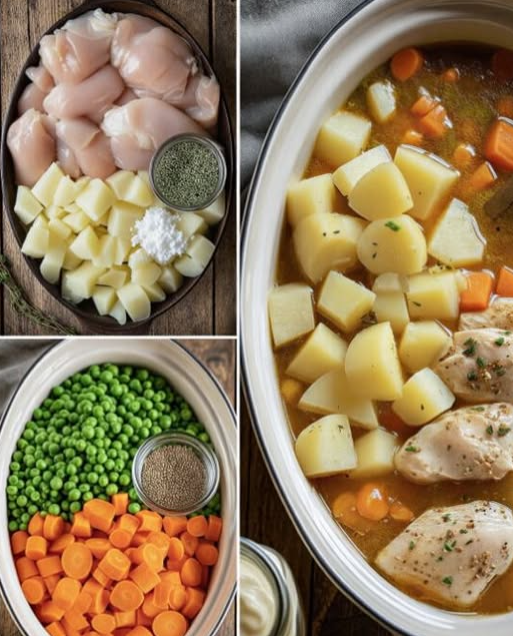
- **Prep Vegetables (UNIFORM CUT RULE):** Dice the **onion** and mince the **garlic**. Chop the **carrots, potatoes, and celery** into roughly 1-inch uniform pieces. Cut the **chicken thighs** into 1-inch pieces as well.
- **Sear Chicken (MAILLARD REACTION):** Heat **olive oil** in a large, heavy-bottomed pot or Dutch oven over medium-high heat. Season the chicken pieces with salt and pepper. Sear the chicken in batches until deeply golden brown on all sides (do not fully cook). Remove the chicken and set aside.
- **Sauté Aromatics and Build Flavor:** Reduce heat to medium. Add the **onion, carrots, and celery** to the pot and cook, scraping up the browned bits (fond) left by the chicken. Sauté for 5–7 minutes until the onions are translucent and the carrots begin to soften. Stir in the **minced garlic** and **tomato paste**, cooking for 1 minute until fragrant.
Phase 2: Simmering and Braising
- **Deglaze and Add Liquid:** Pour a splash of the **chicken broth** into the pot, scraping up any remaining browned bits. Add the remaining broth, the reserved chicken, the **potatoes**, and the woody herbs (**thyme and rosemary**).
- **Simmer:** Bring the stew to a gentle simmer. Reduce the heat to low, cover the pot loosely, and let the stew gently bubble for **45–60 minutes**, or until the chicken is tender and the potatoes are easily pierced with a fork.
- **Thicken (Optional):** If the stew is too thin after simmering, you have two options:
- **Natural Starch:** Mash 1–2 potatoes against the side of the pot to release their starch.
- **Slurry:** Whisk 2 tablespoons of flour or cornstarch with $\frac{1}{4}$ cup of cold water until smooth. Stir the slurry into the simmering stew and cook for 2–3 minutes until thickened.
Phase 3: Finishing and Serving
- **Adjust Seasoning:** Taste the stew and adjust the salt, pepper, and herbs as needed.
- **Serve:** Ladle the **Hearty Chicken and Vegetable Stew** hot, ideally served over rice, egg noodles, or with crusty bread for soaking up the broth.
Serving and Storage: Flavor Development
Optimal handling for this stew:
- **Serving:** The stew is often **better the next day** as the flavors fully meld and the broth thickens slightly from the cooled starches.
- **Storage:** Store cooled stew in an airtight container in the refrigerator for up to **4 days**.
- **Freezing:** Stew freezes exceptionally well. Cool completely, transfer to freezer-safe containers (leaving headspace), and freeze for up to **3 months**. Thaw overnight in the refrigerator before reheating gently.
Tips: Essential Techniques for Stew Excellence
Chicken Selection: Use **chicken thighs** (suggested in the ingredients). The higher fat content prevents the meat from drying out during the long cooking process, resulting in much more tender stew meat than chicken breast.
Mirepoix Base: Do not rush the sautéing of the **onion, carrots, and celery** (Step 3). These aromatics are the foundation of the stew’s flavor. They must soften before the liquid is added.
Tomato Paste: Ensure you **cook the tomato paste** (Step 3) for the full minute. Cooking it down removes its raw flavor and concentrates its sweetness and umami, leading to a richer broth.
Potatoes Choice: Use a **waxy potato** (like red or gold potatoes) if you want the potatoes to hold their shape better, or a **starchy potato** (like Russet) if you rely on the potatoes to naturally thicken the stew (as they break down more easily).
Herb Bundles: To easily retrieve woody herbs like **rosemary and thyme** (Step 4), tie them together with kitchen twine into a small *bouquet garni* before adding them to the pot.
Variations: Customizing Texture and Flavor
Easily adapt the flavor and components of this hearty stew:
- **Vegetable Swap:** Substitute or add root vegetables like **parsnips, turnips, or butternut squash** (Step 1). Ensure they are cut to the same size as the carrots and potatoes.
- **Wine Boost:** Add **$\frac{1}{2}$ cup of dry white wine** (e.g., Pinot Grigio) after sautéing the aromatics (Step 4) and let it simmer until reduced by half before adding the broth. This adds complexity and acidity.
- **Herb Swap:** For a smokier profile, add **smoked paprika** and substitute the thyme and rosemary with a **bay leaf** and a pinch of **marjoram**.
- **Dumplings:** For an extra hearty meal, prepare simple drop dumplings and add them to the simmering stew during the last 15–20 minutes of cooking (Step 5), ensuring they are fully cooked through.
**Simmering Temperature:** Maintain a **very gentle simmer** (Step 5). A rolling boil will agitate the starches and cause the vegetables to break down prematurely, potentially resulting in a cloudy or mushy stew.
**Salt Check:** Stews and braises require significantly more salt than quick-cooking dishes. Wait to perform the final **salt check** (Step 7) until the stew has finished simmering and reduced slightly, as the flavors will concentrate during cooking.
**Flour Coating:** For extra protection against spreading and to aid in thickening (Step 2), you can lightly toss the **chicken pieces** in a tablespoon of flour before searing. The flour will thicken the sauce slightly as it cooks.
**Storage Note:** When cooling, rapidly cool the stew (e.g., transfer to a shallow container) before refrigerating to ensure food safety, especially since it contains chicken and is cooled over a long period.
Conclusion: A Taste of Homemade Warmth
The **Hearty Chicken and Vegetable Stew** is the epitome of comfort food, relying on foundational culinary techniques to achieve its rich depth. By strictly adhering to **The Uniform Cut Rule** for even cooking and perfectly executing **The Browning and Thickening Protocol**, you guarantee a stew with tender chicken, perfectly cooked vegetables, and a savory, robust broth. This recipe is a guaranteed crowd-pleaser and a perfect dish for cold weather.
Frequently Asked Questions (FAQ)
Q: Why is my broth watery and thin?
A: The stew either **didn’t simmer long enough** (Step 5) to allow the natural starches to be released, or it needs a specific thickening agent (Step 6), such as a cornstarch or flour slurry.
Q: Why are my carrots mushy?
A: They were likely **cut too small** compared to the other vegetables (The Uniform Cut Rule, Step 1), or the stew was cooked at too high a temperature (boiling instead of simmering).
Q: Can I use chicken breast?
A: **Yes**, but use caution. (Tip 6). Cut the breast into slightly larger pieces and add them about **20 minutes later** than the vegetables to prevent them from drying out during the long cook time.
Q: Should I add the herbs and spices at the beginning?
A: **Woody herbs** (thyme, rosemary) should go in at the beginning (Step 4). **Delicate herbs** (parsley, chives) should be reserved for the end (Step 7) to maintain freshness.
ADVERTISEMENT