ADVERTISEMENT
Phase 1: Preparation and Base Layering
- **Prep:** Preheat oven to **$350^\circ\text{F}$ ($175^\circ\text{C}$)**. Lightly grease a $9\text{x}13\text{-inch}$ baking dish.
- **Base Layer (MOISTURE MANDATE):** Pour both cans of **peaches in syrup, UNDRAINED,** into the prepared baking dish. Spread the peaches into an even layer. (If desired, sprinkle $\frac{1}{2}\text{ tsp}$ of cinnamon over the peaches).
Phase 2: Dry Layering and Fat Application
- **Dry Layer (HYDRATION):** Evenly sprinkle the **entire box of yellow cake mix** over the top of the peaches and their syrup. Ensure the mix covers the fruit completely. **DO NOT STIR** the cake mix into the peaches. (If using, sprinkle the nuts and remaining cinnamon over the dry mix).
- **Add Fat:** Drizzle the **$\frac{1}{2}\text{ cup}$ of melted butter** evenly over the top of the dry cake mix. Try to coat as much of the dry mix as possible; the butter is what turns the mix into a crisp, brown crust.
Phase 3: Baking and Cooling
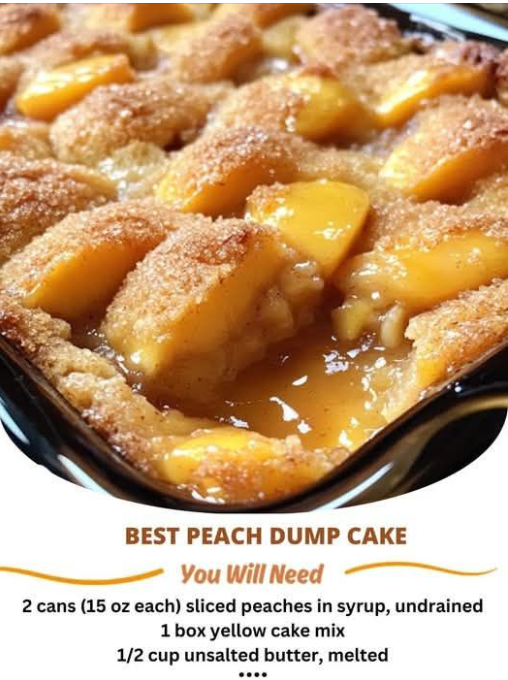
- **Bake (CONVECTION PROTOCOL):** Bake for **$45\text{–}55\text{ minutes}$**, or until the top is deeply golden brown, the filling is bubbling, and the cake mix has mostly set into a crust.
- **Cool (CRYSTALLIZATION):** Remove from the oven and let cool on a wire rack for at least **$30\text{ minutes}$** before serving. The topping will crisp up further as it cools, and the filling will thicken. Serve warm with vanilla ice cream or whipped cream.
Tips: Essential Techniques for Crunch and Moisture
The No-Stir Rule: This is the key technical command (Instruction 3). **Stirring the dry cake mix** activates the gluten and combines the leavening prematurely, resulting in a dense, gluey bottom layer instead of the desired tender, cakey texture.
Butter Distribution: For the crispiest topping, ensure the **melted butter** (Ingredient II) is distributed as evenly as possible. Any dry pockets of cake mix that are not coated by the butter will remain powdery after baking.
The Peaches are Key: The amount of liquid in the **two cans of undrained peaches** (Ingredient I) is precisely calculated to hydrate the standard box of cake mix. Do not drain the peaches, as this will lead to a dry, unappealing cake layer.
Serving Temperature: While this dessert is best served warm (Instruction 6), letting it cool for at least $30\text{ minutes}$ allows the internal steam to dissipate and the butterfat to crystallize, which gives the topping its **final crispness**.
Cake Mix Choice: Using a **yellow cake mix** (Ingredient II) is traditional, as it contains enough fat and sugar to brown well and provides a neutral flavor base. Avoid mixes labeled “low-fat” or “sugar-free,” as they will compromise the texture and browning.
Variations: Customizing Fruit and Flavor
Easily adapt the fruit base and flavor profile of the dump cake:
- **Tropical Twist:** Use **canned pineapple chunks** (undrained) in place of one can of peaches for a brighter, tropical flavor.
- **Cherry Chocolate:** Use one can of **cherry pie filling** and one can of sliced peaches. Substitute the yellow cake mix with a **chocolate cake mix**.
- **Crispier Topping:** For a topping that is more like a crumble, stir $\frac{1}{2}\text{ cup}$ of **oats** into the dry cake mix before sprinkling it over the fruit (Instruction 3).
- **Lemon Zest:** For a brighter flavor profile, finely grate the zest of **one lemon** over the peaches before adding the dry cake mix.
Conclusion: A Technical Triumph of Simplicity
The **Peach Dump Cake** is a remarkable example of how chemical reactions—specifically **passive hydration** and **convection heating**—can create a complex texture from minimal effort. By adhering to **The Hydration and Moisture Control Mandate** and strictly observing the **no-stir rule**, you guarantee a perfect result: a moist, bubbly peach filling topped with a beautifully crisp, buttery crust.
Frequently Asked Questions (FAQ)
Q: Why is my topping still powdery or dry after baking?
A: The **melted butter was not distributed evenly** (Instruction 4), leaving dry spots. Or, the dry cake mix was **piled too thickly** in one area, preventing the butter from soaking through.
Q: Why is the bottom layer gummy instead of cakey?
A: The most likely cause is that the cake mix was **stirred** into the peaches (Instruction 3). Stirring activated the gluten, leading to a tough, gummy texture.
Q: Can I use fresh peaches?
A: **Yes**, but the liquid content must be maintained. Use $4\text{ cups}$ of sliced fresh peaches and add $1\text{ cup}$ of water or juice, plus $\frac{1}{2}\text{ cup}$ of granulated sugar to create the necessary syrup base for hydration.
Q: Can I use cold, sliced butter instead of melted butter?
A: **Yes**, but the final crust will be more like a crumble. Slice the $\frac{1}{2}\text{ cup}$ of cold butter into thin slivers and arrange them evenly over the dry cake mix. This method takes longer to melt, but some people prefer the resulting crunchy texture.
ADVERTISEMENT