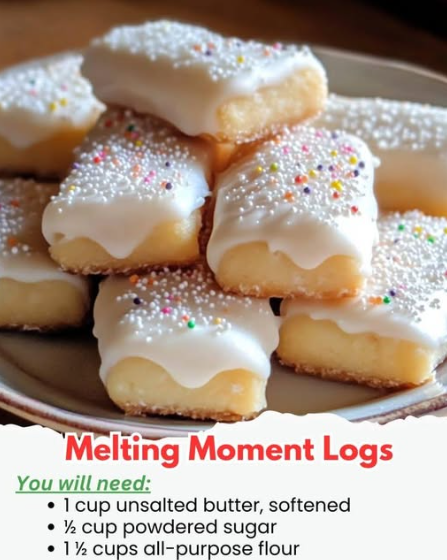
- Prepare the Dough (Creaming): In a mixing bowl, beat the **softened butter** and **$1/2$ cup powdered sugar** together until the mixture is light, fluffy, and visibly paler (about 2 minutes). Scrape down the sides. Beat in the **vanilla extract**.
- Combine Dry Ingredients: In a separate bowl, whisk together the **flour, cornstarch, and salt**. The whisking ensures the cornstarch is evenly distributed.
- Form the Dough (Minimal Mixing): Gradually add the dry ingredients to the butter mixture. Mix on low speed, or fold with a spatula, **only until a soft, uniform dough forms**.
Gluten Control: The goal is to minimize mixing to prevent gluten development. The finished dough should be soft, slightly crumbly, but hold together when pressed.
- Shape the Logs: Take small portions of dough (about 1 tablespoon each). Roll each portion into short, uniform log shapes, about 2 inches long. Place them on a baking sheet lined with parchment paper, leaving a little space between each.
- Bake Low and Slow: Preheat oven to the required low temperature of **160°C / 325°F**. Bake for **14–16 minutes**. The key is to achieve a light, pale bake; the bottoms should be barely golden, and the tops should remain white or very light ivory.
- Cool Slightly: Remove the cookies from the oven and let them cool on the baking sheet for **5 minutes**. They are extremely fragile when hot.
- First Sugar Coat (The Anchor): While still slightly warm, gently roll each cookie in the **powdered sugar**. The slight warmth allows the sugar to adhere better and slightly melt onto the surface, creating an anchor layer.
- Second Sugar Coat (The Finish): Once fully cooled (about 30 minutes), roll the cookies again in fresh powdered sugar for the perfect thick, snowy, and stable final finish.
Serving, Storage, and Mastering the Dough
Serving and Gifting
These cookies are perfect with a cup of hot tea or coffee, as their richness is balanced by the beverage. They are also ideal for gifting, as their stability (once fully cooled and coated) and beautiful appearance make them excellent additions to any holiday tin.
Storage and Enhancement
- **Storage:** Store in an airtight container at room temperature for up to 1 week. *Crucially, they often taste and feel even softer and more “melty” the day after baking.*
- **Dough Freezing:** The unbaked dough can be wrapped tightly and frozen for up to 3 months. Thaw overnight in the refrigerator before shaping, or slice and bake immediately from frozen, adding a few minutes to the baking time.
Dough Handling Tips
Variations: Flavor Infusions
The buttery log base is easily adapted to incorporate a range of subtle flavor profiles, perfect for seasonal variation.
- **Almond Logs:** Replace the vanilla extract with $1/2$ teaspoon of almond extract. Fold in $1/4$ cup of finely ground blanched almonds (almond flour) with the dry ingredients.
- **Citrus Zest:** Add the zest of one lemon or orange to the butter during the creaming stage. The oils in the zest will infuse beautifully with the fat.
- **Cardamom Logs:** Add $1/2$ teaspoon of ground cardamom to the dry ingredients for a subtle, floral, and spicy note.
- **Chocolate Logs:** Replace $1/4$ cup of the flour with $1/4$ cup of unsweetened cocoa powder. This adds a delicate chocolate flavor without compromising the texture.
- **Coconut Logs:** Add $1/4$ cup of finely shredded unsweetened coconut to the dough.
Advanced Baking Tips: Precision in Shortbread
Measuring the Dry Ingredients
The Low-Temperature Bake
Conclusion
Melting Moment Logs are a triumph of simplicity in baking. Their irresistible texture is a direct result of the strategic use of cornstarch to inhibit gluten development and a precise, low-temperature bake. By focusing on quality butter, proper creaming, and gentle mixing, you guarantee a cookie that lives up to its name—soft, buttery, and truly melt-in-your-mouth. These cookies are a perfect addition to any baking repertoire, offering an elegant simplicity that is both comforting and sophisticated.
Frequently Asked Questions
Q: Why is cornstarch used instead of more flour?
A: Cornstarch is used because it provides the bulk of a dry ingredient (structure) without adding gluten-forming proteins. This reduction in gluten is precisely what makes the cookie incredibly tender and crumbly, giving it the characteristic “melting” quality.
Q: My logs spread too much. What happened?
A: This is usually due to the butter being too soft or melted when mixing, or the baking temperature being too high. Ensure the butter is only softened, not liquid, and try chilling the shaped logs for 15 minutes before baking to firm up the fat.
Q: Do I have to use powdered sugar in the dough?
A: It is highly recommended. Powdered sugar contains a small amount of cornstarch and dissolves more thoroughly than granulated sugar, contributing directly to the final smooth, tender texture of the dough.
Note: These cookies are shortbread-style, rich in butter, and best enjoyed in moderation.