
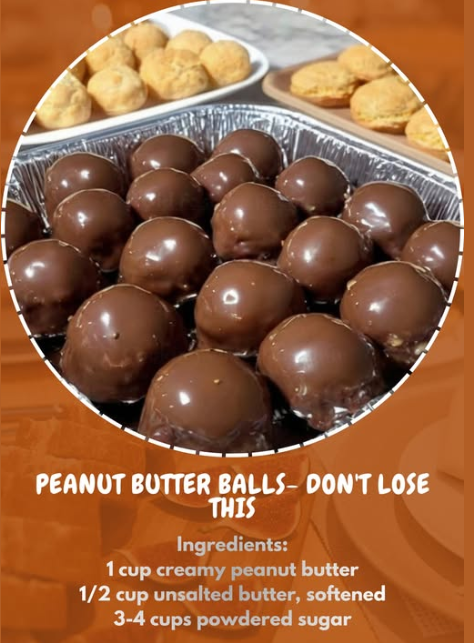
Step 1: The Lipid-Solid Amalgamation
Cream together the peanut butter and softened butter until homogenous. The “Emulsion” Science: You are creating a consistent fat base. Adding the vanilla at this stage ensures the aromatic compounds are evenly dispersed before the solids are introduced.
Step 2: The Saturation Phase (The Sugar)
Gradually add powdered sugar until the dough no longer sticks to your hands. The “Saturation” Rule: You are reaching the Critical Concentration Point. If you add too much sugar, the dough will undergo Friability (crumbly texture); too little, and it will lack Tensile Strength.
Step 3: Geometric Formation
Roll into 1-inch spheres and place on parchment. The “Surface Tension” Physics: Rolling by hand applies warmth, slightly melting the outer fats to create a smooth, sealed surface. Chill for 30 minutes to “set” the butter matrix before dipping.
Step 4: The Tempering of the Shell
Melt chocolate with coconut oil. The “Viscosity” Secret: The oil prevents the chocolate from becoming too thick. You want a Laminar Flow when dipping, allowing the excess chocolate to run off smoothly without leaving heavy ridges.
Step 5: The Immersion and Set
Use a toothpick to dip each ball into the chocolate, leaving a small circle of peanut butter visible at the top (the “Buckeye” look). The “Thermal Shock” Rule: Dipping cold centers into warm chocolate causes the chocolate to set instantly from the inside out, locking in the shape.
Serving and Storage: Maintaining the Snap
Serving: Serve chilled or at room temperature. For the best Organoleptic Experience, let them sit out for 5 minutes so the inner peanut butter softens slightly while the shell remains crisp.
Storage: Store in an airtight container in the refrigerator for up to 2 weeks. Because of the high lipid content, these can also be frozen for 3 months. The “Bloom” Prevention: Avoid rapid temperature swings, which can cause Sugar Bloom (white film) on the chocolate shell.
Tips: Pro-Level “Buckeye” Nuances
- The “Toothpick” Patch: After dipping, use your finger or a small spatula to gently smooth over the hole left by the toothpick for a professional, seamless finish.
- Crunchy Variation: Use “Extra Crunchy” peanut butter to introduce Mechanical Texture. The peanut fragments provide a structural break to the creamy sugar matrix.
- Sifting is Key: Never skip sifting the powdered sugar. Clumps of sugar will create “air pockets” in your balls, leading to structural failure during the dipping process.
Holiday Variations: Seasonal Infusions
| Variation | The Adjustment | The Vibe |
|---|---|---|
| Dark Sea Salt | Use 70% Dark Chocolate and sprinkle with flaky sea salt. | Sophisticated and bitter-sweet. |
| Maple Walnut | Add 1/2 tsp maple extract and roll in crushed walnuts. | Woody, autumnal, and crunchy. |
| White Christmas | Dip in white chocolate and roll in silver sprinkles. | Elegant, festive, and ultra-sweet. |
Conclusion: A Christmas Day Confectionary Victory
Peanut Butter Balls are a masterpiece of Structural Confectionery. By balancing the saturation of powdered sugar with the stability of chilled butter, you create a treat that is both decadent and durable. On this Christmas Day 2025, as you serve these iconic chocolate-dipped spheres, you are presenting a masterclass in culinary physics. Enjoy the snap!
Frequently Asked Questions
- Can I use “Natural” Peanut Butter?
- It is not recommended. Natural peanut butter undergoes Oil Syneresis (separation). This makes it very difficult to achieve a stable dough that won’t leak oil through the chocolate shell.
- Why is my chocolate thick and clumpy?
- This is likely Seizing. It happens if even a tiny drop of water enters the chocolate or if it is overheated. To fix it, stir in another teaspoon of coconut oil or shortening to re-emulsify the fats.
- How do I get the “Buckeye” look?
- Only dip the ball about 3/4 of the way into the chocolate. This creates the signature brown “eye” on top, which is traditional for this specific holiday treat.
Would you like me to suggest a “Graham Cracker” variation of this recipe for a firmer texture, or perhaps show you how to turn these into “Peanut Butter Truffles”?
Related posts:
 Mastering the Ultimate Butterfinger Peanut Butter Balls
 The No-Bake Confection: Mastering Peanut Butter Snowballs
 The No-Bake Confection: Mastering Peanut Butter Snowballs
 Effortless Indulgence: Mastering No-Bake Peanut Butter Balls
 No-Bake Nirvana: Mastering Buckeye Bars
 Mastering Chocolate Peanut Butter Snowballs
