The ingredients show a strategic use of pre-stabilized products for simplicity and reliability.
| Component | Quantity | Functional Role and Technical Insight |
|---|---|---|
| **Cake Structure & Moisture** | ||
| **Mandarin Oranges (with juice)** | 1 can (11 oz) | **Acid and Moisture Source:** Provides liquid for the cake mix and acid to tenderize the gluten structure. |
| **Vegetable Oil** | $\frac{1}{2}$ cup | **Shortening:** Fat that coats flour particles, inhibiting gluten formation for a tender, moist cake. |
| **Frosting Stabilization** | ||
| **Instant Pudding Mix** | 1 package (3.4 oz) | **Hydrophilic Binder:** Modified starches absorb pineapple liquid, rapidly increasing viscosity and stabilizing the Cool Whip foam. |
| **Cool Whip (thawed)** | 1 container (8 oz) | **Foam Base:** Pre-stabilized foam provides the light, airy texture without requiring mechanical whipping. |
Instructions: Incorporation and Minimal Mixing
The directions highlight the importance of proper mixing and cooling before assembly.
Equipment You’ll Need:
- Mixing bowls
- Electric mixer or whisk
- $\mathbf{2 \text{ round } 9 \text{-inch cake pans}}$ (or $\mathbf{1 \text{ } 9 \times 13 \text{-inch pan}}$)
- Rubber spatula
- Measuring cups and spoons
- Cake stand or tray for serving
- **Preheat & Prep:** Preheat oven to $\mathbf{350^{\circ}\text{F}}$ ($\mathbf{175^{\circ}\text{C}}$). Grease and flour your cake pans. This creates a fat layer ($\mathbf{\text{grease}}$) and a fine particulate layer ($\mathbf{\text{flour}}$) that prevents the batter from sticking and climbing the sides during baking.
- **Mix the Cake Batter:** In a large bowl, beat together the $\mathbf{\text{cake mix, oil, eggs, and mandarin oranges (with juice)}}$ for about $\mathbf{2 \text{ minutes}}$. The oranges should break apart slightly. Mixing for $\mathbf{\text{exactly } 2 \text{ minutes}}$ develops the necessary gluten while the fat and acid keep it tender.
- **Bake:** Pour the batter evenly into your pans. Bake for $\mathbf{25\text{–}30 \text{ minutes}}$ for round pans or $\mathbf{30\text{–}35 \text{ minutes}}$ for a $\mathbf{9 \times 13 \text{-inch pan}}$, until a toothpick comes out clean. **Cool completely.** Cooling is essential to prevent the cake from steaming the frosting, causing it to melt or slide off.
- **Make the Frosting (Stabilization):** In a separate bowl, mix the $\mathbf{20 \text{ oz can of crushed pineapple (with juice)}}$ and the $\mathbf{3.4 \text{ oz package of dry instant pudding mix}}$. The pineapple juice rapidly hydrates the pudding.
- **Fold and Chill:** **Fold** the $\mathbf{8 \text{ oz container of thawed Cool Whip}}$ into the pineapple-pudding mixture until smooth and fluffy. **Do not use a mixer; fold gently** to maintain the aeration (air bubbles) of the Cool Whip. Chill for $\mathbf{15 \text{ minutes}}$ to allow the pudding stabilizers to fully set.
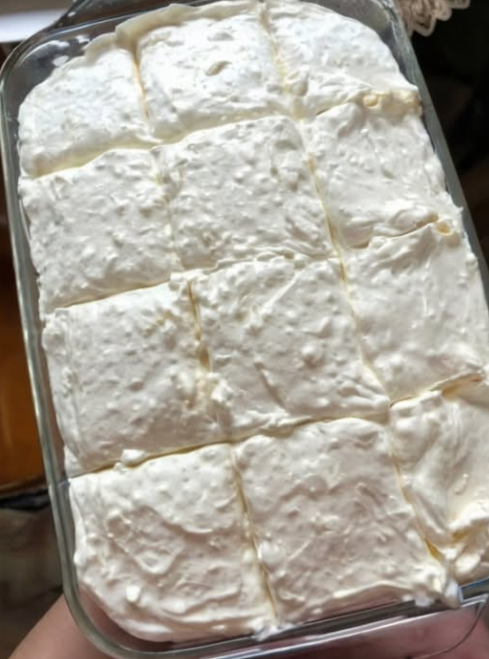
- **Assemble:** Frost the cooled cake layers. If using two round pans, use about half the frosting between the layers, and the rest on top and sides. If using a $9 \times 13$-inch pan, frost the entire top surface.
- **Garnish:** Top with $\mathbf{\text{optional extra mandarin orange slices and shredded coconut}}$ before serving.
Serving and Storage: The Refrigeration Mandate
Optimal Serving and Presentation
This cake is best served chilled, as the frosting maintains its optimal texture only when cold.
- **Moisture Absorption:** Allow the assembled cake to sit in the refrigerator for $\mathbf{\text{at least } 2 \text{ hours}}$ before slicing. This allows the frosting’s moisture to penetrate the cake, resulting in an incredibly moist final product.
- **Garnishing:** The $\mathbf{\text{optional shredded coconut}}$ and $\mathbf{\text{extra mandarin slices}}$ should be added just before serving for the freshest appearance and flavor, as refrigerated coconut can sometimes dry out.
Storage and Longevity
Due to the dairy and fruit content, this cake requires continuous refrigeration.
- **Refrigeration:** Store the cake in an $\mathbf{\text{airtight container}}$ in the refrigerator for up to $\mathbf{5 \text{ days}}$. The instant pudding acts as a preservative, helping maintain the cake’s structure and preventing weeping.
- **Freezing:** Freezing is $\mathbf{\text{not recommended}}$ for the assembled cake. While the cake layers freeze well on their own, the high moisture content of the $\mathbf{\text{Cool Whip/pudding frosting}}$ tends to develop an icy, unstable texture when thawed.
- **Thawing:** If the cake layers are frozen, ensure they are $\mathbf{\text{fully thawed}}$ before applying the frosting.
Tips: Troubleshooting and Enhancing Moisture
Tip: The Cool Whip Integrity
The key to the frosting’s lightness is the $\mathbf{8 \text{ oz thawed Cool Whip}}$. **Do not substitute** with heavy cream that you whip yourself unless you add a significant amount of powdered sugar and a stabilizer (like gelatin or cornstarch). Cool Whip is pre-stabilized, making it far more reliable for this specific no-cook frosting application.
Technical Pointers
- **Do Not Drain Oranges:** Use the $\mathbf{\text{entire can of mandarin oranges, including the juice}}$ (Step 2). The $\mathbf{\text{oil and acid}}$ in the juice are critical to achieving the proper cake moisture and texture. Draining the fruit will result in a much drier, denser cake.
- **Pudding Mix ONLY:** Ensure you are using $\mathbf{\text{instant vanilla pudding mix}}$ (Step 4), not the cook-and-serve type. The **instant** variety contains starches that activate and thicken immediately upon contact with cold liquid (the pineapple juice), whereas cook-and-serve requires heat.
- **Clean Cake Pans:** The process of $\mathbf{\text{greasing and flouring the pans}}$ (Step 1) ensures that the edges of the cake don’t stick or tear upon removal. For extra insurance, use $\mathbf{\text{parchment paper circles}}$ cut to fit the bottom of the round pans.
- **Folding Technique:** When mixing the frosting (Step 5), the $\mathbf{\text{folding motion}}$ is crucial. Gently turn the mixture over and under itself with a spatula. This technique prevents the tiny air bubbles trapped in the Cool Whip from being forced out, preserving the $\mathbf{\text{fluffy texture}}$.
Variations: Adjusting Flavor and Density
The simple cake base and stabilizing frosting allow for easy, flavorful customization.
Fruit and Flavor Swaps
- **Peach Pickin’ Cake:** Substitute the $\mathbf{\text{canned mandarin oranges}}$ with $\mathbf{\text{canned diced peaches}}$ (with juice) in the cake batter, and substitute the $\mathbf{\text{crushed pineapple}}$ with $\mathbf{\text{crushed peaches}}$ in the frosting.
- **Tropical Punch:** Use $\mathbf{\text{coconut milk}}$ in place of the vegetable oil in the cake (if using a scratch recipe, not advised for a box mix). Replace $\mathbf{\text{vanilla pudding}}$ with $\mathbf{\text{coconut cream instant pudding}}$.
- **Spice Twist:** Add $\mathbf{\frac{1}{2} \text{ teaspoon of ground cinnamon}}$ to the $\mathbf{\text{dry cake mix}}$ before combining the wet ingredients to introduce a warmer flavor profile.
Textural Modifications
- **Nut Crunch Layer:** Sprinkle a thin layer of $\mathbf{\text{toasted pecans}}$ or $\mathbf{\text{walnuts}}$ onto the batter before baking for a textural contrast in the cake crumb.
- **Cream Cheese Frosting:** For a slightly richer, tangier frosting, combine the pineapple and pudding mix with $\mathbf{4 \text{ ounces of softened cream cheese}}$ before folding in the Cool Whip. This requires a chill time of at least $\mathbf{1 \text{ hour}}$ to set the cream cheese structure.
Tips: Advanced Baking and Assembly
Tip: Leveling the Cake
If your $\mathbf{9 \text{-inch cake rounds}}$ bake with a domed center, trim the tops flat with a $\mathbf{\text{serrated knife}}$ once they are fully cooled. This ensures a stable, visually appealing stack and prevents the top layer from sliding off the bottom layer when frosted.
Baking Science Deep Dive
- **Egg Function:** The $\mathbf{4 \text{ large eggs}}$ act as both an **emulsifier** (binding the $\mathbf{\frac{1}{2} \text{ cup of oil}}$ and the mandarin juice) and a **coagulating protein** (setting the cake structure). The extra moisture in this recipe requires the eggs to work harder to maintain cohesion.
- **The Box Mix Advantage:** Box cake mixes often contain ingredients like **emulsifiers** (e.g., polyglycerol esters) and **monocalcium phosphate** (a leavening acid) that ensure a consistent rise regardless of the home baker’s altitude or mixing technique. Using the mix is key to the recipe’s foolproof nature.
- **Undrained Pineapple:** Using the $\mathbf{\text{undrained pineapple}}$ (Step 4) is critical because the liquid is necessary to fully dissolve and activate the $\mathbf{3.4 \text{ oz of instant pudding mix}}$. Draining the pineapple would result in a frosting that is too thick and potentially grainy.
- **Cold Assembly:** The cake must be $\mathbf{\text{completely cool}}$ and the frosting must be $\mathbf{\text{chilled}}$ (Step 5) before assembly. Applying cold frosting to a warm cake will cause the $\mathbf{\text{fat and foam structure}}$ of the frosting to melt and collapse.
Conclusion: A Decadent Lesson in No-Bake Stabilization
The **Classic Pig Pickin’ Cake** is a culinary masterpiece of convenience and chemical stabilization. The cake itself achieves its signature moisture through the $\mathbf{\text{acidic and liquid properties of the mandarin oranges}}$. The light, airy frosting is a triumph of $\mathbf{\text{no-bake confectionery}}$, relying on the rapid $\mathbf{\text{hydration of instant pudding stabilizers}}$ by the pineapple juice, which subsequently locks the $\mathbf{\text{Cool Whip foam}}$ in a stable, light, and delicious matrix. The resulting cake is a perfect balance of moisture, flavor, and effortless assembly.
Frequently Asked Questions:
Q: Can I use fresh mandarin oranges instead of canned?
A: $\mathbf{\text{Not recommended}}$. Canned mandarins, with their juice, provide the $\mathbf{\text{precise liquid and sugar content}}$ needed for the box mix to behave correctly. Fresh fruit will have different moisture levels and may require additional liquid to prevent the cake from being dry.
Q: Can I make the frosting with homemade whipped cream?
A: $\mathbf{\text{Yes, but it’s less stable}}$. Homemade whipped cream lacks the long-term stabilizers found in Cool Whip. If you use it, ensure you whip the cream with $\mathbf{\text{powdered sugar}}$ and ideally $\mathbf{\text{gelatin}}$ before folding in the pudding/pineapple mixture. The chill time (Step 5) becomes even more critical.
Q: My cake layers stuck to the pan, even though I greased them. Why?
A: You likely did not **flour** the greased pan (Step 1). Greasing the pan prevents sticking, but flouring provides tiny particles for the batter to adhere to, which prevents the climbing and final tearing upon removal. Always $\mathbf{\text{grease AND flour}}$ when using classic cake pans.
Q: Why does the recipe say to use the whole can of pineapple, undrained?
A: The $\mathbf{\text{liquid (juice)}}$ in the can is essential! It is the primary liquid that dissolves and activates the $\mathbf{3.4 \text{ oz of instant pudding mix}}$, creating the necessary thick, stable custard base for the frosting. Draining the pineapple would leave the frosting dry and grainy.