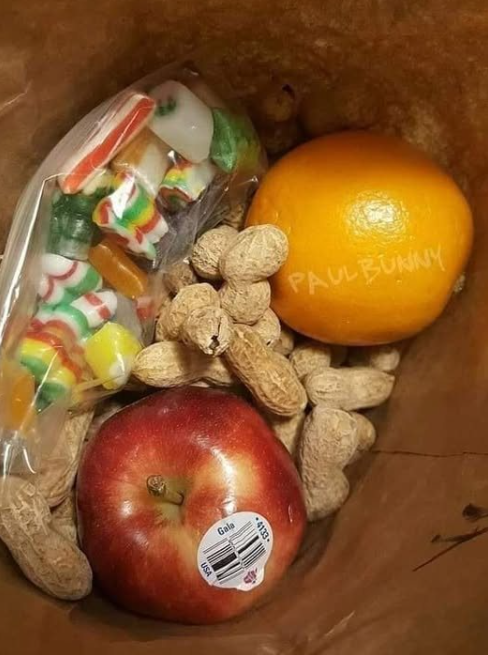
While the legend provided the spiritual foundation, the Great Depression solidified the tradition as a symbol of resilience. For families who could not afford manufactured toys or expensive goods, the items seen in this image were a rare and cherished luxury.
The “Biological Luxury” of the Orange
During the 1930s, an orange was not just a snack; it was a vibrant boost of color and health. Chemically, the orange provided essential Ascorbic Acid (Vitamin C) at a time when fresh produce was scarce and scurvy remained a threat in winter months. It signified health and good fortune for the coming year.
The “Cellulose Scaffold” of the Apple
The red Gala apple in the bag represents successful harvest preservation. In an age before global shipping, apples were kept in root cellars to last through the winter. A crisp, unbruised apple in late December was a testament to domestic engineering and provided necessary fiber and natural fructose.
The “Mechanical Engagement” of the Peanut
The inclusion of whole peanuts provided more than just protein and healthy lipids. The act of “shelling” a nut provides a mechanical engagement, slowing down the consumption process and making the gift last longer during a time of scarcity. This transformed the act of eating into a social and ritualistic event.
Nutritional Matrix of the Traditional Holiday Bag
From a biological perspective, this bag is a perfectly engineered winter supplement kit:
| Item | Biological Component | Functional Benefit |
|---|---|---|
| Orange | Ascorbic Acid (Vit C) | Immune support and gold symbolism. |
| Peanuts | Lipids and Protein | Long-term energy and “earned” satiety. |
| Apple | Pectin and Fructose | Digestive health and rapid glucose. |
| Hard Candy | Amorphous Sucrose | Energy density and festive sensory stimuli. |
Conclusion: Why “Kids Today” Might Not Understand
The user’s prompt notes that “kids today wouldn’t understand this.” In a world of instant digital gratification, it is difficult to perceive a piece of fruit as a “treasure.” However, the history of this bag teaches us about the physics of scarcity: value is inversely proportional to availability. To a child in the 1930s, the bright orange was more valuable than a plastic toy because it represented global trade, vitality, and the literal legend of a saint’s gold.
The “Paul Bunny” inscription on the orange in the photo further personalizes the gift, turning a commodity fruit into a bespoke heirloom. This bag remains a masterpiece of simple wealth, reminding us that health, good fortune, and family are the most valuable treasures one can receive.
Frequently Asked Questions
- Why an orange and not another fruit?
- The orange’s spherical shape and golden-orange hue most closely mimicked the legendary bags of gold thrown by St. Nicholas.
- What did the nuts symbolize?
- While the orange was the “gold,” the nuts and apples signified the literal fruits of a family’s labor and the health required to survive the winter.
- Is this tradition still practiced?
- Yes, many families still place an orange in the toe of a stocking to honor the history of “simple wealth” and to pass the story of St. Nicholas down to new generations.
Would you like me to suggest a way to turn these traditional ingredients into a modern holiday recipe, or perhaps help you write a letter to explain this tradition to a younger family member?