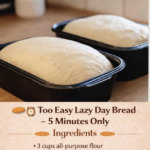
Step 1: Mixing the No-Knead Dough (5 minutes)
- **Mix Dry:** In a large bowl, whisk together the **flour, dry yeast, and salt**. Stir in the **finely chopped garlic**.
- **Combine Wet:** Add the **warm water** and **olive oil** to the dry ingredients.
- **Mix Shaggy:** Using a wooden spoon or spatula, mix until all the flour is hydrated and the mixture forms a **shaggy, very wet, and sticky dough**. Do not overmix; just ensure there are no dry spots of flour remaining.
Step 2: The Long Fermentation (12–18 hours)
- **First Rise:** Cover the bowl tightly with plastic wrap or a damp towel. Let the dough rest at **cool room temperature** ($65–70^{\circ}\text{F}$ or $18–21^{\circ}\text{C}$) for **12 to 18 hours**. The dough should at least double in size, be bubbly, and have a beautiful, complex fermented aroma.
Step 3: Shaping and Final Proof (2 hours)
- **Prep Surface:** Generously dust a work surface and your hands with flour. The dough will be very sticky.
- **Turn Out:** Gently scrape the dough out of the bowl onto the floured surface.
- **Shape:** Fold the edges of the dough into the center (like folding a business letter) until you have a rough round shape. Gently flip the dough over and cup your hands around it to tighten the surface tension into a round loaf.
- **Second Rise:** Place the shaped dough seam-side down on a piece of parchment paper. Dust the top lightly with flour. Cover loosely and let it proof for **45 minutes to 1 hour**. While proofing, preheat the oven.
Step 4: Baking for the Perfect Crust
- **Preheat:** Place a 5–6 quart **Dutch oven (or heavy cast-iron pot)** with its lid inside the oven. Preheat the oven and the empty pot to **$450^{\circ}\text{F}$ ($230^{\circ}\text{C}$)** for at least **30 minutes**. The hot pot is essential for the crust.
- **Transfer and Cover:** Carefully remove the hot pot. Lift the dough using the edges of the parchment paper and place it, parchment and all, into the pot. Cover the pot with the lid.
- **Bake Covered:** Bake for **30 minutes** with the lid on. The trapped steam creates the signature thin, crispy crust.
- **Bake Uncovered:** Remove the lid and continue baking for another **15–20 minutes** until the crust is deep golden brown.
- **Finish:** Remove the bread from the pot and place it on a wire rack. Brush the top with **melted butter** mixed with **garlic powder/herbs** while the bread is still hot.
- **Cool:** Cool completely on a wire rack before slicing (at least 1 hour) to allow the steam to escape and set the crumb.
Serving and Storage: Maximizing Freshness and Crunch
The Ideal Pairing
This savory loaf is excellent on its own, but its flavor profile makes it perfect for dipping into olive oil with balsamic vinegar, serving alongside Italian pasta dishes, or using as a base for bruschetta or thick soup croutons.
Storage and Longevity
This bread is best eaten the day it is baked. To store:
- **Same Day:** Store cut-side down on a cutting board at room temperature.
- **Longer Storage:** Place the cooled, unsliced loaf in a paper bag (not plastic) at room temperature for up to **3 days**.
- **Re-Crisping:** To restore the crunch, sprinkle the bread lightly with water and bake in a $350^{\circ}\text{F}$ ($175^{\circ}\text{C}$) oven for 5–7 minutes.
Tips: Troubleshooting and Technique
Tip 1: The Dutch Oven Substitute
If you don’t own a Dutch oven, you can bake the bread on a baking sheet. Place a shallow pan on the rack below the bread and fill it with hot water immediately after placing the dough in the oven. This creates steam but will not be as effective as a Dutch oven.
Tip 2: Troubleshooting Sticky Dough
The dough is intentionally very sticky. If it is too difficult to handle, use a **bench scraper** rather than your hands to manage the dough. Dusting the work surface generously with flour before the shaping step is the most effective way to prevent sticking.
Tip 3: The Garlic Factor
Ensure the garlic is very finely chopped or grated. If the chunks are too large, they can burn and turn bitter during the long, high-heat bake. Alternatively, substitute the fresh garlic with 1 teaspoon of **garlic confit** for a sweeter, more subtle flavor.
Variations: Customizing the Loaf
1. Cheesy Garlic Loaf
After the shaping step (before the second rise), gently fold in $\frac{1}{2}$ cup of **shredded Parmesan cheese** and $\frac{1}{2}$ cup of **shredded mozzarella cheese** into the dough. This creates a gooey, savory interior perfect for dipping.
2. Herb and Garlic Bread
Add **2 tablespoons of finely chopped fresh herbs** (such as rosemary, thyme, or oregano) to the dry ingredients along with the fresh garlic. Brush the finished loaf with melted butter mixed with the same herbs.
3. Sandwich Loaf Twist
Instead of baking the loaf freeform in a Dutch oven, shape the dough into a log and place it in a greased standard loaf pan (9×5 inches) for the second rise. Bake uncovered at $375^{\circ}\text{F}$ ($190^{\circ}\text{C}$) for 45–55 minutes. This creates a loaf perfect for slicing for sandwiches or toast.
Advanced Tips: Fermentation and Oven Spring
Tip 4: Cold Fermentation (Advanced Flavor)
For an even more intense, complex sourdough-like flavor, substitute the 12-to-18-hour room-temperature fermentation with a **24–48 hour cold fermentation** in the refrigerator. After the initial mix (Step 1), place the covered bowl directly into the fridge. Proceed with shaping (Step 3) once you remove it from the cold, allowing a longer second rise (about 1.5–2 hours) to let the dough warm up.
Tip 5: Enhancing the Crust (Scoring)
Just before placing the dough in the hot Dutch oven, use a sharp razor blade or knife to make a single, shallow cut (or *score*) across the top of the loaf. This controls the expansion, allowing the steam to escape evenly and promoting a better oven spring (the rapid rise in the oven).
Tip 6: Achieving Maximum Oven Spring
Ensure your oven is at the **full $450^{\circ}\text{F}$ ($230^{\circ}\text{C}$)** temperature and that the Dutch oven is equally hot before transferring the dough. The quick blast of high, moist heat is what creates the impressive rise and open crumb structure typical of no-knead bread.
Conclusion: Effortless Elegance in Baking
The No-Knead Garlic Bread recipe proves that world-class flavor and texture do not require strenuous effort. By allowing time and quality ingredients to do the heavy lifting, you achieve a bread with a perfect balance of savory garlic, a chewy, porous interior, and an irresistibly crispy crust.
This is the definitive recipe for those seeking a rewarding, hands-off baking project that yields a flavorful, aromatic loaf perfect for any meal.
Frequently Asked Questions: Troubleshooting and Prep
Q: My bread came out dense and flat. What went wrong?
A: The most common causes are **undercooking** (not enough oven spring) or **over-handling** the dough during shaping. Be gentle during shaping (Step 3) to preserve the gas bubbles created during the long rise. Ensure your oven and Dutch oven are fully preheated to $450^{\circ}\text{F}$ ($230^{\circ}\text{C}$).
Q: Why is the inside sticky even after cooling?
A: This is usually due to **undercooking**. The internal temperature of a fully baked loaf should reach $200–210^{\circ}\text{F}$ ($93–99^{\circ}\text{C}$). If the loaf browns quickly but remains doughy, reduce the oven temperature to $425^{\circ}\text{F}$ ($220^{\circ}\text{C}$) and continue baking for another 5–10 minutes.
Q: Can I use whole wheat flour?
A: Yes, but whole wheat flour absorbs more water. Substitute up to $1/4$ of the all-purpose flour with whole wheat, but you may need to add an extra 10–20 ml of water to maintain the wet, shaggy consistency.
Q: What is the benefit of the long, slow rise?
A: The long, cool rise allows natural enzymes (amylases) to break down starches into simpler sugars, which the yeast then consumes, producing a complex, nutty flavor usually associated with sourdough. This flavor is impossible to achieve with a quick, two-hour rise.