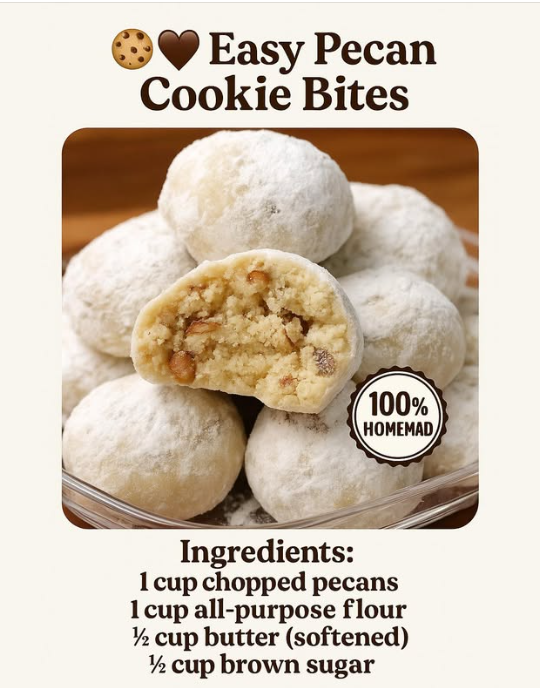
The ingredient list is simple, relying on quality fats and proper ratios:
I. The Core Cookie Base:
- **1 cup** all-purpose flour
- **½ cup** unsalted butter, softened (The primary tenderizer)
- **½ cup** packed brown sugar (For moisture and chewiness)
- **1** large egg
- **1 tsp** vanilla extract
- **½ tsp** baking powder (Assumed, for lift)
- **¼ tsp** salt (Assumed, for flavor balance)
II. The Flavor Enhancer:
- **1 cup** chopped pecans (Pre-toasted is mandatory)
- **Optional:** Powdered sugar for dusting (Assumed for a traditional finish)
Instructions: Creaming, Chilling, and The Final Dust
Phase 1: Preparation and Aeration
- **Toast Pecans (CRITICAL FLAVOR STEP):** Spread the **1 cup chopped pecans** on a dry skillet or baking sheet. Toast over medium heat or in a $350^\circ\text{F}$ oven for **5–7 minutes**, until fragrant. Allow to cool completely.
- **Combine Dry Ingredients:** Whisk together the **1 cup flour, ½ tsp baking powder, and ¼ tsp salt** (assumed) in a medium bowl.
- **Cream Fat and Sugar:** In a large bowl, beat the **½ cup softened butter** and **½ cup brown sugar** on medium-high speed until light, fluffy, and significantly paler (about 3–4 minutes).
- **Add Wet Ingredients:** Beat in the **1 egg** and **1 tsp vanilla extract** until fully combined, scraping down the sides as necessary.
Phase 2: Dough Formation and Controlled Spread
- **Mix in Dry:** Reduce the mixer speed to low. Gradually add the flour mixture until *just* combined. **Do not overmix.**
- **Fold in Pecans:** Fold in the cooled, **toasted pecans** using a spatula.
- **Chill Dough (MANDATORY):** Wrap the dough tightly in plastic wrap and refrigerate for a minimum of **30 minutes**. Chilling prevents excessive spread during baking.
- **Shape and Prep:** Preheat the oven to **$350^\circ\text{F}$ ($175^\circ\text{C}$)**. Line a baking sheet with parchment paper. Roll the chilled dough into small, uniform balls (about 1 tablespoon each).
Phase 3: Baking and Finishing
- **Bake:** Place the dough balls 2 inches apart on the prepared sheet. Bake for **12–15 minutes**, or until the edges are light golden brown. The centers may still look slightly pale and soft.
- **Cool Slightly:** Remove the cookies from the oven and let them cool on the baking sheet for **2 minutes** (they are fragile when hot).
- **Transfer:** Carefully transfer the cookies to a wire rack to cool for another **10 minutes**.
- **Final Dust (Optional):** If desired, immediately after transferring to the wire rack (while still warm), dust the cookies generously with **powdered sugar**. This gives the classic pecan sandy look.
Serving and Storage: Maximizing Freshness
The high fat content of this cookie means they stay fresh and tender for a surprisingly long time.
- **Serving:** Serve cooled completely. The texture is best once the butter has fully re-firmed after baking.
- **Storage (Room Temp):** Store in an **airtight container at room temperature for up to 5 days**. The flavor actually improves slightly after the first day.
- **Freezing Dough:** The raw dough freezes excellently. Roll it into a log, wrap it well, and freeze for up to 3 months. Thaw overnight in the fridge before slicing and baking.
- **Freezing Baked Cookies:** Freeze baked cookies in an airtight container layered with parchment paper for up to 3 months. Thaw at room temperature.
Tips: Essential Techniques for Tender Dough
Ingredient Temperature: The **½ cup butter** (Step 3) must be truly **softened** (room temperature, easily dented, but not melted). Cold butter won’t cream properly; melted butter results in a thin, greasy cookie.
Toasting the Pecans: Do not skip Step 1. Untoasted nuts have a raw flavor that detracts from the cookie’s buttery richness. Watch them carefully while toasting, as they burn quickly.
The Dough Texture: The dough (Step 6) will be **stiff and slightly crumbly**, not runny. This texture is necessary for maintaining the bite-sized shape and achieving the “sandy” texture.
Preventing Overmixing: Once the flour is added (Step 5), mix only until the flour streaks disappear. Overmixing develops gluten, turning the sandy texture into a tough, chewy one.
Altitude Adjustment: At high altitudes, increase the **all-purpose flour** by 1 to 2 tablespoons and slightly reduce the baking powder (if used) to prevent excessive spreading.
Variations: Customizing Nut and Sugar
The simplicity of the base recipe allows for easy flavor swaps:
- **Walnut Bites:** Substitute the **pecans** with **chopped, toasted walnuts**.
- **Spiced Bites:** Add **½ teaspoon of ground cinnamon** and a pinch of **ground nutmeg** to the dry ingredients (Step 2) for a warming spice flavor.
- **Glazed Finish:** Instead of powdered sugar, create a simple glaze from **powdered sugar and milk** (or maple syrup) and drizzle it over the cooled cookies.
- **Chocolate Drizzle:** Melt 1/4 cup of semi-sweet chocolate chips and drizzle them over the cooled cookies instead of dusting with powdered sugar.
- **Espresso Lift:** Add **1 teaspoon of espresso powder** (or instant coffee powder) to the dry ingredients (Step 2) to deepen the cocoa notes in the brown sugar.
Flour Toasting: For an even richer, more complex flavor, briefly toast the **1 cup all-purpose flour** (Step 2) on a baking sheet at $350^\circ\text{F}$ for 5 minutes and let it cool before using. This caramelizes the starch proteins.
The Brown Sugar Substitute: If you only have granulated sugar, you can add **1 tablespoon of molasses** (or dark syrup) to the granulated sugar to mimic the flavor and moisture benefits of brown sugar (Step 3).
Baking Sheet Cooling: Never place fresh dough on a hot baking sheet (Step 9). The residual heat will cause the cookies to melt and spread immediately, defeating the purpose of chilling the dough.
Cutting Uniformity: For even baking, ensure the cookie balls (Step 8) are all the **same size**. Using a small cookie scoop is the best way to achieve this consistency.
Conclusion: The Reward of Patience
The **Easy Pecan Cookie Bites** are a testament to the fact that simple ingredients yield extraordinary results when technique is precise. Mastering the creaming method for aeration, pre-toasting the pecans for depth, and strictly adhering to the chilling protocol ensures a batch of perfectly formed, sandy-textured, melt-in-your-mouth cookies. This recipe is an effortless way to create a classic favorite with a noticeably superior crumb.
Frequently Asked Questions (FAQ)
Q: Why did my cookies spread too much and come out thin?
A: The most common causes are using **melted or very soft butter** (instead of softened), or **skipping the mandatory chilling step** (Step 7). The fat must be firm going into the oven.
Q: My cookies are hard and tough, not sandy. What went wrong?
A: You likely **overmixed the dough** (Step 5) after adding the flour. This develops gluten, which makes the cookies tough and chewy instead of tender.
Q: Can I use oil instead of butter?
A: You can, but the texture will change significantly. Oil will produce a **softer, denser cookie** that lacks the characteristic buttery crispness and the sandy crumb that results from the creaming method.
Q: How do I store the dough if I want to bake cookies later?
A: Roll the dough into a log, wrap it tightly, and **refrigerate for up to 5 days** (Step 7), or **freeze for up to 3 months**. Slice and bake directly from the refrigerator/freezer.